Thursday, September 20, 2007

Day 3

Hola! :)
Work on the church began today!

The trenches were dug around the perimeter and large rocks placed in them. Cement was made constantly and poured over the rocks. It is nice that we don’t have to mix the cement by hand, as we have a small mixer.
The children loved to help out and one little boy would carry the cement bags in a wheelbarrow and wanted to dump them out for us. It was cute to watch, as the cemento bags weigh about 100lbs and the little boy weighed only about 50 pounds, but he was determined to help out. The next step was setting up the wooden frame around the perimeter for the cement foundation.

Carolyn was chased by a gander on her way to the washroom and we found out from a little boy there that ganders do indeed bite because his ankle had been attacked earlier. The Yucra family, on whose land we are building the church, built us Canadians a washroom in their horse pen. It is a hole in the ground with some boards for privacy. We are sure you can imagine the fun we have with such a small hole… The fact that this family went out of their way to build us such a nice washroom though is very thoughtful and sweet! They would do anything for us to make us feel more at home and that speaks so much to us!

For dinner, some of the Bolivian woman cooked us a large meal. We sat in the hut which they had also built just for us to have shade, and the first thing brought to us was soup made of vegetables and meat. We were all getting full from the large bowl of soup, when out came the next part of the meal which was a large bowl of rice, meat, lentils, tomatoes, etc. We had to tell them little (pequeno/ poco) because we cannot eat that much! They gave us oranges for dessert. That is one thing that is so amazing; all the fresh fruit that is grown right here. We have lots of bananas and oranges fresh from the trees. We had time to have devotions which Irene led and talk before we got back to building. We got two of the main walls filled with cement in preparation for bricklaying tomorrow, but the process took a long time and we didn’t get finished until past sundown, but it was only nearing 7:00.

A few of the Bolivian women and Marg prepared a huge meal for us! They had three different salads and pork and hamburger with rice. Marg figured that there would be much left over but we ate close to everything! All the families that could make it from the community came for this meal and we set up tables outside under the stars. The gringos sat in the midst of the Bolivians and using Marg and Jake as our translators carried out short conversations with one another. After the meal each one of us from the team told the Bolivians a little bit about ourselves; our families, things we like, where we live and so forth. Marg translated for us. A few of us had pictures and they loved to see all the babies from our families. Children are very important to the people here. After everyone left it was time to unwind and get ready for bed and get some rest for a new day. :)

Monday, September 17, 2007

Building the Church at Patujusal Days 1 and 2

Hola to everyone!

Our team, consisting of Irene Prins, Ray VanderKooi, Peter Kuipers, Lisa Breukelman, Carolyn Tiemstra and Francine Tiemstra, arrived saftely in Patujusal, Bolivia Saturday morning after 32 hours of travel. The flight from La Paz to Santa Cruz allowed us to view the Andes Mountains which are just magnificent and a reminder of the Rockies. The city of La Paz is high above sea level and therefore are breathing was much more difficult.

We were greeted at the Santa Cruz airport by Jake, Marg and Marcos, one of the men from a nearby community. We split up into their truck and a taxi and began our drive to Patujusal. The taxi holding Marg, Carolyn, Francine and Lisa had a good start. For the gringos, there was much to take in! We stopped at a roadside market for some juice. The driving in Bolivia is quite different from Canada as there are no rules whatsoever and honking is not a rude thing to do, but rather, a way of telling other drivers that you are coming up beside them or next in a traffic circle. There were many sugar cane trucks on the road as well.

The taxi got a flat tire soon after starting out on the gravel road. Thankfully, the driver had a spare and although it took some time to change the tire, we were soon on the road again. The road got a bit worse and once again we had a flat tire. This time there was no replacement tire and therefore we had to wait it out on the side of the road. There was a small store close by which was a blessing. We were not stranded in the middle of nowhere which was a good feeling. The people were in a meeting so as soon as they were done (which took a while) they opened the store so we could buy something to drink. It was here that the marriage proposal occurred between Lisa and one of the local men. This man figured that Lisa could be Bolivian and was very beautiful. He kissed all our arms. We had resigned to waiting for possibly 4 hours for the men and Irene to come by on their way from Santa Cruz. The taxi driver finally decided to work on fixing one of the tires with the men at the store and as usually and ironically happens, as soon as the tire was fixed, the truck drove up. To say the least, it was a relief!

We transferred our luggage from the taxi onto the already full truck and four of our team sat on top of the truck and the rest in the cab. The tires were sitting very low. Irene had three dozen eggs on her lap and it was difficult to keep them all intact and it was beginning to appear as though we would have scrambled eggs.

The truck with Jake, Pete, Ray, Irene and Marcos had gone from the airport to Santa Cruz and then on to Yapacani to pick up supplies which included melons, potatoes, chickens and more. They found it quite funny to see us gringos on the side of the road waiting for them to pick us up. We drove a ways and once again we experienced a flat tire but were able to get it fixed right away.

The rest of the drive allowed us a better view of the jungle and we got to see a large iguana crossing the road and running into the soya plants. We passed the school which the children attend as well. The road we were on was very dusty as it has not rained for a long time and rather bumpy because in areas the river had redirected itself and left large rocks and ruts.

We stopped at the Yucra family’s place which is also where we will build the church. The Yucra family donated their land for the church and they are amazing people! They were very welcoming to us. The wife, Sedila, had a baby a week ago and he was bundled up in blankets.

Just a couple miles down the road is Jake and Marg’s land and home. They have a wonderful and cozy home surrounded by the beautiful jungle! We pitched our tents outside and had a delicious meal of peanut soup and buns. We were all tired from our travels and therefore, retired early to bed.

Sunday morning we went to church at 8 and at first it appeared that due to a community meeting we would just go home and hold a small service there. But soon enough, people started showing up on their motos (motorcycles) and by walking or hitching rides on trucks. We sang some hymns in English and the natives sang hymns in Quechua, their native language and then in Spanish. We were greeted with a hand shake, touch on the arm and another hand shake, the traditional greeting. After more people arrived we moved our service into the thatched roof hut they built for us there. The children were very excited! Singing was accompanied by lots of clapping. Marcos read a passage in Spanish from Matthew 7:7-12 and Marg gave a talk on God’s wisdom. We brought greetings from WoodyNook and Pete made the analogy of how in Canada and in Bolivia we stare at the same sun and how we all serve the same God as well. We may be miles apart but we are united by the same God as we are by the same sun. It was truly a wonderful feeling to see the strong faith and love for God that the people here express! It is encouraging and inspiring.

Sunday afternoon was a relaxing time spent talking and learning from one another about the natives, the land, customs and our own reasons for coming and thoughts about everything. Marg, Irene and Lisa took one of the men from the community who was quite sick to the hospital in La Pista and the men went to the river to fish. The men came back with 10 fish which Marg prepared in the traditional way and fried them for supper. The little girls of the man who was taken to the hospital went fishing and caught two fish for us as a thank you for taking their father to the hospital. We had a wonderful supper of fried fish, rice and salad.

We begin work on the church early tomorrow morning so we are all heading to bed now. Ray, Irene and Pete have tents pitched in the front yard and the rest of us sleep in the house. All the best with everyone! Until next time…God bless

Saturday, August 18, 2007

Dust or mud?


They say that there are two seasons for the roads – mud or dust – and we are deep into the dust season. We reduced the number of passengers that we will take in the truck since we really don’t want anyone sitting in the back in all the dust. Even though the doors and windows are shut, the cab is full of fine dust. The fan and air conditioner will be cleaned during our next trip to the city.

When we returned from Canada we were met with a great surprise. As we turned the corner at La Pista to head to Patujusal we were amazed to find an upgraded road. The holes that went to China had not only been filled, but the whole road was elevated about 2 meters. We think that it might be a bit of overkill but we are happy that we no longer dodge pot holes. However, nothing is ever ‘finished’ in Bolivia, so we encountered ‘montañas’ instead. When the machine pushed the dirt from 5 meters on either side of the road, it moved across the road, leaving gouges at every width of the blade. Natural speed bumps!

In Patujusal 2 changes also occurred. The parts of road that caused the most problems during the last flooding season have been elevated. Rumor has it that the total road will be elevated, eliminating the flood problems. Some of us are minus entrances to our places but that seems to be a minor concern.

Today, some sections of the road are covered with up to 5 cm. of fine, flour-like dust. We are waiting for some rain. The lumber trucks can then compact the road. The new owner of the lumber company that has the lumber concession appears to be willing to work with the community so we hope that the road will be maintained this year.

Friday, July 20, 2007

Vacation????

After a month in Canada we are back in Bolivia. It was a busy, interesting month in which we did not get much rest. We started the time off by making a whirlwind trip to Iowa with Kurt, Sherry Ann, Sophia and Kolten (our son and his family). While there we made a presentation of our projects to some of Jake's family. Back home again to celebrate the graduation of our grand daughter, Katelyn. Another milestone in our lives!

Then we made a huge decision, something we had no intention of doing. We put our acreage up for sale. It was not an easy decision and I still have a hard time with it. It was the land on which my grandfather farmed when he moved to Canada from Holland. But times have changed and it is no longer financially feasible to keep it. But listing it meant that we had to pack up all our 'stuff' and store in in a trailer until we decide what to do. We changed our tickets and 'bought' a couple of extra days to get all the work done. Of course, that didn't happen and our kids were left with the last of the cleaning.

But there were happier things. We celebrated the wedding of our niece as well as my birthday and Tim's (our other son) birthday. My sister came from Ontario, so we had a chance to visit.

The weather was scorching hot for Alberta but we felt right at home. I was able to drive my car with the top down for more than a week! The grandkids loved being able to move the roof of the car up and down although they didn't appreciate the wind when riding in the back seat.

We spent time organizing a team to come to Bolivia to build a church building in our little community. We were heartened by the support and the the willingness of people of come. We are looking forward to a group arriving in the middle of September. Our next month will be busy with planning and purchasing supplies.

So we are back in Bolivia, complete with a scanner, a new camera, the inverter and a few more things but minus the canna bulbs I wanted to plant.

Sunday, June 03, 2007

GRACIAS!

Living in another country makes you realize the gift of friends, both old and new. Jeanine came to visit. I did not know her and we crossed ways because she came into Santa Cruz a day early to ensure that she would be on time for her flight home. She came to Bolivia on a mission trip to help at some orphanages but had many questions about Bolivia – its culture, its problems, the people, the poverty, and the solutions to some of the problems. Most of all she wanted to know what impact, positive and negative, that short term missions had on the people.

As we talked, she shared with me that she was reading a book by a priest who had worked in Bolivia in the ‘80’s. She loved the book and the insights shared by the priest. It was a thought provoking book and led to many deep discussions. It was evident that this book had changed her and had given her a different perspective on life and faith.

The day she left, she said she wanted to give me the book that had meant so much to her. She was hesitant about giving me, an evangelical, a book by a Catholic priest; a book that asked many questions about the people from the first world working in the third world. When she handed it to me, I cried. It was Gracias! by Henri Nouwen – one of my favorite authors. She was relieved and overjoyed and I was thrilled with it.

In reading Gracias! I see that there has been many changes in Bolivia in the past twenty years but that many things have not changed. Nouwen challenges all of us to look at what we are doing and how we are influencing what happens in developing countries without being judgmental. There are so many times I was saying “Yes” and “Thank you” while reading. He asks many of same questions that I ask and although he does not have solutions, it is inspiring and gratifying to read his view on these challenges.

Jeanine and I both found that some people avoidd the book because it was written by a Catholic. That is sad; they are missing out on a great inspirational read. I challenge you to get the book from the library, or better yet, buy a copy, read it and be moved. Gracias from the bottom of my heart, Jeanine!

Gord, the Guinea Pig Man

Early in May we had a visitor from Canada. Marg first met Gord Gilchrist briefly a couple of years ago when she was on the Board of Olds College and Gord was an instructor there. While visiting the office of “A Better World’ in January, she read an article that said that Gord had worked on an alternative energy project in Africa and she also was told that he would be coming to Bolivia in May. She extended an invitation for him to visit the farm.

After thirty hours on the plane, Gord spent another 5 hours riding in the truck to Patujusal. Throughout the conversation, it became evident that we struck a gold mine of information. I don’t call it just coincidence that Gord raised guinea pigs and is one of the four qualified guinea pig judges in Canada – and we plan to raise guinea pigs. He also raises the older variety of chickens that are more suitable for this area so we will be able to secure eggs for new breeding lines without bringing them in from USA. Then his area of expertise is alternative energy, GPS and mapping. The day flew by and soon we were back in Santa Cruz enjoying a steak dinner at one of the ‘local’ restaurants.

Marg went to Santa Cruz to check on the carnets and passports, only to find that Gord and one of women of his team would be arriving the next day. What a blessing! Saturday was spent wandering around one of the markets and the central part of Santa Cruz. It was a great opportunity to share some of the culture of the country, to talk about its problems and to discuss the position of mission and NGO groups in developing countries.

We were thankful for all the information we received from Gord and were thrilled that we could fulfill one of his dreams. He wanted to see a South American guinea pig farm and we knew just the place. Zenón Flores raises about 1000 guinea pigs per year, as well as ducks, chickens, hair sheep and cows. We spent Sunday afternoon at the farm and it was a relief to hear Gord say that the guinea pigs were high quality since we plan to use this as our breeding stock.

The most amusing part of the experience is Gord’s name. The locals have ahard time saying it so Gord asked about ‘gourd’ in Spanish. Calabeza just didn’t make the grade. So we kept calling him Gord. However, our friend Zenón, asks us about Gordo each time we visit. I am not sure how Gord likes to be referred to as ‘fat’ – but that is a compliment in Bolivia. We are very grateful for the time Gord spent with us and we look forward to working with him in the future.

Illegal Aliens!

A Reason for Rejoicing

We want to be permanent residents of Bolivia. When we arrived a year ago we were advised to get a ‘permiso’ since it was much cheaper than a regular carnet. However, the laws have changed and everyone is now required to have a carnet. The law also says that you must first apply for a one year carnet, then a two year carnet and then a permanent one. However, the lawyer explained that things could be done differently and who were we to argue?

We still are not sure how things proceeded but we know that our passports were sent to La Paz and have come back saying that we are now permanent residents of Bolivia. The lawyer began the legal documentation for the carnets and we should be the proud owners of carnets when we get back from Canada.

The biggest problem is that our ‘permiso’ to drive has also expired and because we have lived here for more than three months, we cannot drive on an international license. We cannot get a drivers license because we do not have the carnet. We tried to get an extension on the ‘permiso’ but were not able to do so. Although we are told verbally that it is still good, we are not taking chances and are restricting our trips to the city.

Changing with the Seasons

Blog time again. I can tell that we lived here a year already. All the things that were so new last year are now normal. The changes are incredible when we think back but our life has acquired a rhythm. Now that the rainy season is somewhat over and the helpers are coming back, construction is also happening.


It is fall. The temperature is dropping and it seems like we are getting more south winds this year, bringing cooler weather. We are not complaining since it makes working outside much more pleasant but the locals are freezing. They sit in the house with three or four layers of clothing and are still shivering. Both of us have resorted to wearing a sweatshort or light jacket early in the morning and later in the evening but during the day we are in our shirt sleeves, much to the amazement of the neighbours.

José is busy working on the second building that now has a name- El Centro de Capatación. If we called it an education center people think that we are starting a school. We did not want to call it a ministry center since people will think that it is a church. So we were calling it a multi purpose building for lack of a better name, but that sounds rather mundane. But the other day, a friend called it ‘el centro de capatación – a name that does not translate well into English. It literally means qualification but the nuances are toward learning. So, work began and is continuing for the present. The road is still soft so we have not been able to get in the sand and word is that the river is too high right now. We definitely need sand to continue. We are taking in cement, a few bags at a time, every time we go to Yapacani.

Although we are making in back and forth from town to the farm, it is a challenge. More often than not, Jake chains up the tires so that we can proceed. Thankfully, the river silt is solid enough that we can drive over it, but it is a challenge to stay on the road. The truck that was blocking the road is now gone and the cat is moved to the side so driving is getting much easier. The biggest problem is the ruts – some that reach to Asia. There are promises that the road will be fixed – next month – so we will see when it actually happens. We hear that they have calculated 50 hours of cat work needed to fix the road in Patujusal 2. However, when the 50 hours of work is completed, that is it, even if the road is not completed. There is a channel project in the river that does not work. Why not? Because they miscalculated the number of hours needed and they ran out of hours before the channel was completed – so it doesn’t work!

José is eager to complete the building. He is in a quandary right now but we cannot find a way to help him. His wife, Juana, and their children, Moises, Karen, and Katleen are living in Santa Cruz. Moises is at the age where he either moves from the community or no longer attends school. So the family moved to the city, leaving José behind. Juana is able to find work as a maid in Santa Cruz. She loves to work and there is nothing for her in the community. José, although an excellent mason, prefers the campo and realizes that he needs something for himself. He is 40 years old and knows that in a few years he will no longer be hired because of his age. It is a no win situation. We would like to offer both José and Juana full time work but that means that Moises would likely be apart from the family. We pray that things will work out as time goes on.

This is a typical situation in Bolivia. Some of the schools go to grade 4, others to grade 6 and others to grade 8. After that, the students go to Yapacani or another city to school. Often the boys further their education and the girls remain in the campo. We have a number of neighboring families where the mother and some of the children live in the city and the father and some of the kids remain in the campo. They visit back and forth but do not operate as a single unit. Some of the women have a vegetable stall in Yapacani to help with the family income but we are not sure that they make much money. The whole situation does not bode well for family unity.

This situation is difficult for the schools also. The school in Patujusal has lost about 10 students in the past year but the school at Km. 32 lost over 20 students. As the schools loose students, they close. When we travel to Yapacani, we find that the schools between Km. 23 and Yapacani have all been closed because the families have moved into the city.

Tuesday, March 13, 2007

And back at the campo --- Water and Mud

Remember I wrote that we walked out through all the water. That was the beginning of the rainy season and we are hoping and praying that it will end. Jake choose to remain in the chaco for the entire time and was one of the five or six residents. The woman and children moved to other communities and the men stayed either at their chaco or with their families.

The December flood was only the beginning. By the middle of January the road had been flooded five or six times and the worst was yet to come. In the end of the month all of Bolivia was deluged with rain, so much that it made international news and calls for relief. Our community is situated very close to the Yapacani River. There is a loop in the river and when there is a lot of water flowing the flat land surrounding it gets covered since the water does not make the curve. The water just covers all the land with water and silt. There is really no way to explain all of this -- pictures will do it better. Apologies to those who have a hard time uploading this.

In early December we thought that the road was bad. The night before the rains the cat had disturbed some of the clay and made the road very slippery and difficult. After this espisode we went to Santa Cruz and bought chains.

The water covers about 2 kilometers of road. It is a low spot and the water runs straight through one of our neighbour´s house and yard. The top picture on the left is the house in early January (forget the date on the pic) and picture on the left is the same place in mid March. The yard has not dried up.

Although the water was a serious problem it recedes rather quickly and is usually done within a couple of days. But what is left behind is more of a problem. There is about a meter of silt dunes that resember snow banks in the road. These also extend into the rice fields. Some of the rice has been ruined by the rain and the silt since the heads were covered with water. Other is ready to harvest but it is very wet and muddy in the fields making it difficult to get people to assist with the harvest by hand.

The other day they tried to get a tractor in to take in the combine but the tractor became stuck in the mud and the owner returned home, leaving behind a very rutted road.

The road has to be opened. Jake offered to hire a cat to clean the road but the owner of the cat said it was too hard to do and would take about 40 hours just to move the silt. I am sure that he thought that he would never get paid for all his time. There is also a problem because there is no convenient place to put all the silt.
So it seems that we are still at square one with the road. There is a layer of dried silt that seals the water underneath. The men of the community built a cordoroy road using tree trucks and branches to cover the silt. In the areas where there are the silt dunes they loosened them with a spade and then moved as much clay as they could by hand. It was remarkable to see all them working, laughing and talking, knee deep in mud. But my night they were much quieter and very tired. They built the road well enough for Jake to get the truck out, for which we are very thankful. The next job was to get the tractor and the combine in. The men were very confident that that could be done. The challenge would be hauling the rice out on the wagons through all the mud.

Thursday, March 08, 2007

A Visit to the Campo


Our first visitors arrived at the campo even though we were not prepared. Intentions were to have the house completed before they arrived but the rain squelched all those plans. So Karmen and Jo had to survive some of the trials we experience in the jungle.

Our friend, Dionisio, was kind enough to drive us in to the community so we did not have to ride the local micro. We could leave during the day and walk in when it was light. The road showed all the effects of the floods -- many washed out areas, many areas full of nothing but mud. The trip took an hour longer than usual but we were able to drive to within a kilometer of the house. Although Jake had sent pictures of the mud, I was still amazed at the condition of the road. For about 2 kilometers there is nothing but silt dunes. Imagine meter high snow drifts but instead it is all silt. You can walk on the top but just under the surface there is nothing but wet clay. The men from the community were laying tree trunks across the road to built a road for the tractor and combine. The rice is ready to harvest and timing is important or the rice will fall. We walked about a kilometer to the house and we won´t dwell too much on the shape of the house.

First job was to get some lunch ready and Jake still had some soup left over. Jake harvested some fresh moringa so the girls had a taste of that in the soup. I thought it was a bit heavy with moringa but Karmen said that she liked it. After lunch the girls rested and talked while I organized the kitchen. Most of the women have left the community. There are only 5 people living in Patajusal 2 and the girls said they could understand why they left.

The truck was thoroughly stuck in the mud so Jake, Jose and Dionisio spent the afternoon digging it out. Talk about muscles and patience. Jack it up, put boards under it, jack it up, put boards under it -- until it is level with the road and it could be driven out a few feet. Something was broken on the front wheels and oil was leaking so Jake returned to Yapacani with Dionisio and the women stayed at the house.

Having only women in the house was probably a good thing. Supper was -- you guessed it -- rice! But with sou sauce and with sugar and cinnamon. We played some cards but soon it was time for bed. Following a sponge bath in the bathroom with the tile floor we were all ready to crawl into the tent. Since Jake was not home we all slept together in the tent and the girls did not have to use the mosquito nets! I think they were relieved.

The next morning we had a wonderful breakfast of Grandma´s scrambled eggs and real ketchup! Our morning walk was interrupted with more rain and it continued for about two hours. Yes, it interrupted the walk but worse, it made things worse for the men who were trying to repair the road. Will it ever end!! In the afternoon the girlds decided to bake a delicious chocolate cake from Grandma Siebenga´s recipe.

Jake and Dionisio returned and quickly fixed the truck. Everything was working but Jake would not drive out the truck since there are a lot of parts of trees sticking out and he doesn´t want to damage the truck. So he stayed in the community to help with the road and wait for the tractor to compact the road. Then he will come out. The girls and I returned to Yapacani with Dionisio on a road that was much worse than the day before.

So much for impressing Karmen and Jo with the community and the work we do. They wondered what I did all day and they found out that it was much easier to get homesick out there without any communication and not much to do when it rains. I wish they could go back to Canada with a better experience.

More travels with Marg

Can you imagine an overweight, out of shape, fifty plus Grandma touring Bolivia with two attractive, slender, teenager girls. It did happen and we all survived.

Karmen and Jo are 19 and 18 respectively and experienced their first adventure in Bolivia. Coming from the modern North American world, it was a shock to find out that things do not happen on time or may not happen at all.

Carnaval is a South American experience that we didn´t think they should miss so we stayed in Santa Cruz for the weekend. The parade was scheduled for Saturday night but was cancelled due to rain. We heard it was rescheduled for 5 the next evening but in the morning that paper said it would start at 10. So off we went. The girls were a bit of a sensation and became the target for friendly foam and water spraying. It didn´t take long for them to purchase there own cans of foam and retaliate. And you can guess what happened next. Everything was in good fun until the paint spraying started and none of us appreciated that. Although there is some respect for the older people, we did get some paint on our clothes. The parade finally came but by then we were hungrey, burnt, and tired and didn´t even stay for the whole thing. The three women suffered from the affects of sunburn for the next few weeks.

Plans were to travel. It was not possible to go to the house due to mud and silt dunes so we thought that after a couple of weeks things would be better. Jake headed home and the women headed off. Due to the amount of rain in Bolivia many of the roads were closed with mud slides. Instead of taking the bus to Sucre as planned, we flew. Yes, it was a half hour ride instead of 8 hours by bus but we didn´t see the countryside. Sucre is a beautiful city and is the judicial capital of Bolivia. It is nestled in the hills (mountains) and is known as the white city. The hotel was downtown and close to the markets so the girls could shop to their hearts content. We didn´t do Sucre justice. We decided to go to a water fall which was supposely a twenty minute drive from the city. We were told that we could walk--not! It was more like an hour from the city center and would have included a long walk over many hills in the hot sun. We took a taxi and wondered if we would every find it. We didn´t. We saw the area in which the falls are located but would have had to hike for 3 hours to see the waterfall. I have a suspicion that there was a road to the falls but the taxi driver was unwilling to take it. We planned to go to the Children´s museum but it was closed. So much for Sucre.

On we went to Potosi, the highest city in the world and at one time, the richest city in the Americas. The economy is based on silver mining and the city has fallen on much harder times. We had the opportunity to tour the silver mine, an experience that I will leave to the younger crowd next time. It was mind boggling to imagine that people work in those conditions without the safety regulations that we are used to. We also toured the mint museum where all the money was made at one time. Although Potosi has a lot of history it is not as attractive as Sucre. It was good for me to visit this area since many of the people that we live with come from here.

Busses do not run frequently to the small community of Uyuni so we took the night bus -- another 8 hour ride through the darkness, arriving at 2 in the morning. Try finding a hotel at that time of night! We thought we had reserved a place but they didn´t receive the email. Thankfully we were able to find a place for three. There were still many people walking around looking for a place at that time of night but they were not willing to spend the money on a bit more expensive place. It costs us 45 bolivianos or about $5.50 to $6.00 each that night.

The next morning we left on the more interesting part of the trip, the Salar de Uyuni 3 day trip. The three of us, along with a couple from Denmark and a young girl from France and the driver, loaded ourselves into a 4 wheel drive and started on the trek. Only a couple of kilometers out of town we hit the salt flats and from then on we had to have faith in the driver. Due to the amount of rain we were travelling through between 12 and 18 inches of water on top of the salt. Imagine what that does to the engines! At this point there were a lot of vehicles, all travelling in the same direction toward the Salt Hotel. This building is totalling made of salt -- the building, the beds, the tables, everything. But it is closed due to contamination. Imagine a building closed in Bolivia! They are now building a new faciltity with a better sewage system.

From the hotel we headed once again into the horizon - literally. I tried to determine how the driver knew where he was going but I could not find the landmarks. I imagine that after driving the same ´róad´for years, you know where you are going. At this stage there was no longer any water and we drove over salt. hearing it crunch under the tires. A delicious lunch of potatoes, llama, and veggies was served and after lunch we were encouraged to walk around Fish Island. We didn´t even make it half way around and turned back due to heat and tiredness from our time in the mine. Next time. This island, one of 63, is in the middle of the salt flats and is covered with cacti. From Fish Island we again headed into the horizon with much less company. Day trips only go to Fish Island and then return to Uyuni. After a couple of hours of driving through nothing but salt we arrived at some thing -- either another island or the edge of the salar. Our driver decided to take one of the roads and told us not to be scared. We were not sure of what but it soon became clear that we were driving through mud, the kind of mud we have in the community. It wasn´t long before the bald tires were covered in mud and we were stuck. Unlike North America, people don´t stop. It wasn´t until we sent out Karmen and Jo that another group stopped. They looked at the situation and said they would send help from the village about a kilometer away. No one came. Thankfully a couple of other vehicles did stop and we finally got out. Now only to describe it. They took the spare tire off, placed it on the ground and put a 4 x 4 on top of it for more height. Then they took a long pole, placed it under the wheel nuts and leveraged the whole truck up. While a number were leveraging the truck, others placed rocks and boards under the tire until it was level with the road and then we could drive out. We arrived at our hotel in plenty of time and enjoyed a piping hot shower before our supper. Lights went out literally at 9.

Dawn came about 5:30 and we were on the road by 7. The salt flats were now behind us and we drove by small fields of quinoa and then nothing but desert type plants. The whole day was spent driving through some of the more desert areas of southern Bolivia. Some of it resembled the badlands of Alberta but the wind erosion was much more evident. One of the highlights were the flamingos. We could not get as close to them as we would have liked but were able to get some good pictures. Unfortunately though, they all disappeared with the computer. By evening we were high up on the Altiplano and experienced some colder weather. All of us were bundled up in sweats and blankets. It is hard to believe that most tourists go here in the winter when the weather is down to -30C. There was no hot water and so no showers. But we did have electricity for two hours so some were able to charge batteries on cameras, I Pods, etc.

3:30 in the morning, What a time to get up. But we were to be on the road by 4:30 and we made it with a minute to spare. The first few hours were spent driving in the dark. The point was to get down to the bottom of the park and then come back in the light. It was still dark when we passed the geysers and the cold and lack of light didn´t make it a great experience. The next stop was the hot springs. Although the water was warm there was a lot of algae present and that did not make the experienec that pleasant. But we can say that we sat in the hot spring in Bolivia. The rest of the day was a long drive back to Uyuni. I wished that there was more time for photo stops but it was not to be. The colors were a painter´s palette and there is no way to describe it. The rock formations were incredible. We did have a couple of incidents -- one was getting a little stuck in a creek and the other was a flat tire when we were about an hour out of town. I know that there are not many tools in the vehicles in Bolivia and understood that we did not have a spade or shovel when we were stuck in the mud, but not having a jack was something else. Thankfully, again, another vehicle stopped and helped us. We made it back to Uyuni safely and spent the next few hours waiting for the train to Oruro.

If there were train service throughout Bolivia, I would use it. This was a wonderfully smooth ride without all the stops. We travelled through part of the night, leaving at about 3 in the morning and getting to Oruro at about 9:30. The scenery around the lake was beautiful and it was a relaxing ride. From the train station in Oruro we had to go the bus station. Things were very busy and hectic there and during this hassle I had my computer stolen. What a way to end a good vacation! We could not change our tickets so had to leave right away so I could not even look for it. Not only was my computer taken but also all the cords to the rest of my electronic equipment and my identification. However, our passports are in La Paz so we still have those. Somehow I will survive without Bolivian ID until I leave again. The scenery from Oruro to Cochabamba is absolutely gorgeous but the whole trip was shadowed by the loss of the computer and by the infomercial guys who were selling health supplements, videos, and hand cream. What a way to travel. Our ears are still ringing.

We arrived in Coch, spent a day there, and planned to take the bus to Yapacani. But it was not to be. The roads were still closed, or closed again, due to mud slides so we ended up flying back. In all honesty, I don´t think any of us minded that we were not spending another 8 hours on the bus. We arrived safely back in Santa Cruz and spent the night in wonderful beds at the New Tribes Mission. What a treat to be back.

Travels with Marg

The river came rushing down the road the evening of December 21, announcing the beginning of flood season. Plans for Christmas in Santa Cruz were in place and we were eager to get out and have some quiet time. I had hoped that the house would be completed by Christmas and I needed to make some mental adjustment when I realized that would not happen. Now I was hoping for everything to be done before the girls came in January. We were expecting our first visitors -- my grand-daughter, Karmen, and her friend, Jolyn. We were hoping to give them a good experience so that they would go home and spread the word that we had a wonderful place.

But everything changed with the rains. We, along with some of our employees, decided to walk out on the morning of the 22nd. There were about 10 of us in all. The waters started about 100 meters from our driveway and it was not long before we were walking in water up to our calves, and at one point, up to our thighs. That was not bad for us -- imagine the height on our short Bolivian friends! We walked about 3 kilometers through the water and then hit the dry ground. From that point on we walked periodically through water but at one point it was thigh deep and running rapidly. After I had a bit of a spill, we all joined arms and walked across that section together. If only I had had my camera on that trip but I had left it in Yapacani.
The length of the journey was about 11 kilometers and although I would like to say that I managed it well, I have to admit that I rode a moto part of the way. When we arrived at the La Pista corner we waited for some type of transportation for the rest of the way to Yapacani. Marcos went to the next town to try to get a taxi but was unable to do so. So we ended up riding in the back of a three ton farm truck, along with the goats, sheep, fish, produce and people. It was an experience but not one that I would want to do every day. It gave us an appreciation for the local transportation available but also made us really appreciate our truck! Meeting the locals was a great experience. We realized that we were well known in the communities as the people who picked them along the road when they were going to town. What goes around, comes around!

We spent Christmas with friends in Santa Cruz and I ended up staying in the city until I left for Canada. There was constant rain in the city and I knew that every drop would make its way into the campo at some point.

While in Canada I spent time with the the kids and grand kids. It was a memorable, and emotional, occasion to witness the baptism of our grandson, Kolten. We also celebrated the birthdays of our oldest grand daughter, Karmen, and our youngest grand daughter, Sophia. It always is great to see the kids. We also celebrated another birthday -- the 60th birthday of my sister, Agnes.

Plans were that I would fly out on February 9 and the girls would come on Feb 12. So I was at the airport on time, went through customs and security in about 15 minutes and thought things were going great. But the plane never left due to a mechanical difficulty and I stood in line for the next three hours to rebook the flight. Understandably, I was unable to make my connections after that time and I was quite sure that this would not be easy. Santa Cruz airport has a habit of being short of jet fuel so flights are regularly cancelled. It turned out that I was not able to catch another flight to Santa Cruz until the next Thursday. Jake took care of the girls when they came and I enjoyed the luxury of a first class flight and a restful night in a hotel in Miami. Finally I returned to Bolivia but was still not able to go home -- but that is another story.

Apologies!

Sorry, it has been some time since I wrote in the blog. There are a number of reasons for this. First, I spent the month of January in Canada and was somewhat unaware of what was going on in Bolivia. Then I went on a two weeks whirlwind Bolivian tour with my grand-daughter, Karmen, and her friend, Jo. One this tour I lost my computer -- I think it was stolen. So all my information and pictures are gone for now. Thankfully, I backed up all the information when I was in Canada. Talk about God at work. I have never, never, in the twenty some years that I have used the computer, have I backed things up unless I was bringing the computer in for a problem. So I am very grateful that I have all my pics and info in Canada. The only thing I am missing is the pictures from the trip but I am sure that we will go there again. Karmen has pics that I can use. However, the blog will not be as colorful for the next while until I can obtain a new computer along with pen drive to transfer information. I am very thankful that it was only the computer and not one of the girls. Can you imagine if I had to explain the unexpected disappearance of one of them! But I am over the woulda, coulda, shoulda and am going on with life.

Sunday, December 31, 2006

THE ROAD IS CLOSED!!

The last month has been frustrating! More often than not we have a ‘trunca’ across the road when we wish we enter or leave the community. The road in Patajusal 1 and 2 crosses private land so literally belongs to the community. Anyone who uses the road does so only with the permission of the members of each community.

The main ‘user’ of the road is the lumber company. An agreement was made that the company could use the road provided it would build the road and maintain it. The company built the road by cutting a swath with a cat through the forest and they maintain it by driving on it. Logs cut from farmers’ fields are hauled day and night while the weather is good. But there is a problem. All this driving puts holes in the road and when it rains, the holes get deeper since the trucks drive straight through. After some time the road is nothing but potholes and the community decides to stop all traffic until the road is repaired.

This is the problem with which we were faced in November. We could understand why when the road was wet since we could see the damage. Even though our truck is light we still try to be considerate of the community. But when the road was dry we became quite frustrated – until we realized what was happening.

One day I returned from Yapacani after attending a meeting there. The weather was fine and I did not anticipate any problems. But when I came to the entrance of Patajusal 1 the trunca was closed. I had taken some people with me and they checked at a couple places for the key but were unable to find it. I walked to the school and the store but at neither place did I find the key. So what do I do – turn around and go all the way back to Yapacani or stay in Hotel Chevrolet for the night? The people from the community are always warning me that it us unsafe to drive at night but does that include sleeping in the truck in the middle of nowhere? Let’s just say that I have spent much more comfortable nights. The next morning I returned to one of the places where I was told the key would be. They had returned from the field the night before and they gave me the key after making me promise to bring it back as soon as I opened the gate and also promise that I would not let anyone else through. I was home in time for breakfast and a nap!

Another day we were expecting some supplies for the workshop and had obtained permission for this truck to enter. We received the key with the usual conditions of letting no one else through. When I arrived at the gate the truck was there as well as the road grader. But the man from the road grader, who happened to work for the lumber company, would not allow me through the gate. After some very frustrating conversation, I went home and told Jake to deal with the problem. He went to the gate and negotiated that the truck could come through in one hour. Part of the problem was that I was a woman and there is no way that a man will let a woman tell him what is going on. And then when I had the key, there was no recourse except to stick to his guns. When Jake came, things could be negotiated. It was at this time that we realized that there was some serious negotiating being done with the lumber company. The company wanted to grade the road even though there were wet spots and the community leaders wanted them to wait. From that time on, one of the members of the community was assigned to stay by the trunca and open it for those who were allowed to pass through but to keep the lumber company from moving trucks. We appreciated that since we did not have to look for a key every time we went in and out of the community.

The road has now been ‘fixed’ in Patajusal 1. They raised it so that water does not run over it as quickly, but it is still made of clay which causes great problems when it is wet. It is not unusual for the micro (the bus that provides public transportation) to be stuck somewhere on the road. One night we were coming back and made sure that we were at the trunca when the micro would come through. It had been a bit wet but we were sure that we could make it. After a couple hours of waiting we were told that we could only go to one of the farms but we would have to wait there until morning. However, the micro could go through. So we stopped at the farm and Jake stopped the micro so that we could get a ride. Then the people on the bus decided that we could go down the road after the bus. So off we went – for a few hundred meters. Then the micro decided that it could go no further and would back down the road. Then we could go – if we took the people and the cargo. Although we were loaded down much heavier than we wanted, we agreed and we were able to make it to our own beds. Not another night in Hotel Chevrolet!!

But now we have another problem. The road is fixed in Patajusal 1 and they have started construction in Patajusal 2. A bridge needs to be built to divert some of the water so a large hollow tree about 5 feet in diameter is put across the road. The first time I encounter it I am somewhat concerned about how I will get over it. One man (my dear friend from the lumber company who has his truck in the middle of the road, waiting to get through) tells me that it will be in the morning but another man says an hour. It is lunch time. It turns out to be about 20 minutes and they tell me I can go through. OK, but how and where. I make my way up the ‘bridge’ and get high centered. No problem! They hook the wench from the cat on to my truck and pull me through. But the next time it is not so easy and that time Jake is driving. It takes an hour or so to get out the next time and we are glad that the guys have a great sense of humour and adventure. Not only is the lumber truck still in the middle of the road, but also the cat has broken down and is sitting on an angle across the road with the blade in the air. Thankfully Jake has some experience although this is worse than driving on snow covered ice. He figured out how to manoever the truck through the greasy mud and we were able to move in and out of the community once again.

But things changed again. We planned on taking a few days of R and R over Christmas but the day before we planned to leave the road was closed – and we could do nothing about it. Although we did not have a lot of rain, there had been ten days of rain up river and all that water comes down to Patajusal. There is a curve in the river where the water flows into the community and the night before we were to leave, the river literally came down the road. By morning the road was covered from our laneway toward the crossing in Patajusal 1. That meant that we had a choice – stay in the chaco or walk out. I had made sure that all the fruits and veggies were eaten so that nothing would spoil while we were gone. So that reduced our options and we walked out. There were 10 of us who waded through about 2 miles of knee deep water with slimy clay under foot. Many of our neighbours had water running through their houses and the chickens were perched on the roof. It reminded me of the newscasts of the floods and hurricanes, except this was something we were experiencing. Words cannot describe, nor would you believe, what it was like. (And where was the camera – safe and dry in Yapacani. Although I wished I had it with me, it probably would have fallen in the water since I am such a coordinated person that I fell as soon as we started!) Fields that were green with rice the day before were now lakes as far as the eye could see. At the bridge we walked through water to our hips and the bikes we had with us were covered in water. I was wearing shorts so did not have a problem. Some of the men didn’t have a problem either – they just took off their pants and walked in their underwear and then dressed again at the end of the adventure.

Most of Patajusal 1 was dry but we did encounter a few spots where the water was running over the road. The worst part was about 100 yards of fast flowing waste deep water. We formed a line and all went through together. Then it wasn’t far to the corner at La Pista where we waited for some type of transportation that would take us to Yapacani. It ended up being a farm truck but we were happy to ride with the sheep, the fish, various types of produce and about 20 other people in the back of the truck. It was an experience.
So how is the road now? I have no idea. Jake left for the chaco by micro three days ago and I have not heard from him since. Hopefully he is safe in the house and is just waiting for the road to be dry enough to pick up the truck.

Congratulations Leonarda and Crisobal

Sometimes couples get married in Bolivia. Most of the people we know are not officially married although they have been living together and have established homes and families. There is difficulty obtaining the proper documentation for marriages so the ‘official’ status is not something that is easily obtained. There is no stigma if a couple is not officially married.

But one of our part time employees, Cristobal, and his wife, Leonarda, decided to get married. This was going to happen in September but the papers were not in order until a week before the wedding in December.

If you get married in La Pista, the church puts on the wedding and covers the expenses, I think. But then the minister and his wife were the padrina and madrina so maybe they covered those expenses. All we know is that the couple did not pay for the wedding. Each person in the church and a number of people of the community were asked to bring something. We were asked to pay for the wedding cake along with two other people. Others were asked to bring pop and others prepared the meal. Two days before the wedding Leonarda came with us to Yapacani to buy a dress. Now who in Canada would wait that long!

The wedding was to start at 2 so we came around one. The noon meal still had not started. I was to take pictures and was surprised that both the bride and the groom were wearing the clothes they wore every other day. It was about 3 o’clock when Jake was asked to come into a room and I went in with him. Things had changed. They wanted Jake to tie the groom’s tie. Now, Jake will have to learn this – it is the second time that he has had to do this. The bride was now dressed up and things were starting to look more like a wedding. A minister came from Cochabamba for the wedding and his wife took along all the finery that went along with a wedding – the bouquet, rose petals, veil. We decorated the church with flowers that we picked from the garden at the hospital.

Finally things were ready and the service started. First came three little girls spreading rose petals, then the groom and his madrina, and the bride and her padrina. The service was much the same as in Canada except that there was a part where they placed a gold chain around the couple signifying that they were tied together for life. They wore it until they got out of church and then the woman wore it.

After the service there was the gift line and each person received a bottle of pop and a bag of tostatos (puffed corn) when they presented their gift. The gifts were not opened but put away to be opened later. Following this, everyone enjoyed a dinner of chicken, rice, and yuca. It was nice to be just a member of the congregation with no extra privileges.

After dinner there was a bit of a program with some music and activities and then the night was over. It was only 10 o’clock so it seemed very early for a Bolivian celebration. Everyone went home and the bride and groom and their children went to their house – and life goes on.

A Milestone for Lidia

While you in North America were busy with Christmas preparations we were experiencing a different type of festivity. December marks the end of the school year and with that comes graduations or promocións. We were asked to be padrina and madrina for the promoción of one of the young girls from Patajusal 1. We know her father but we really did not know her so we were rather surprised, and a bit anxious, when we were asked. We had heard that being a padrina or madrina carried a lot of responsibility and that there was usually a fair bit of money involved. But we were assured by the father that all we had to do was attend the ceremony and come to the house for a little meat, and at a later time assist her in making her decisions about what she wants to do after graduation. After reading some information, both positive and negative, we felt that we should agree since it appeared that it was an honor more than an obligation.

But there were some obligations, although not the type that we would have thought. We were asked to be at the school at 3 so that they would know everyone was ready but instead they were at our place in Yapacani at that time asking if we would pick up the tables and chairs and bring them to the house. Then the pop had to be picked up. That was done and the time had changed to be at the house by 5 so we were there but the father was still in the shower and we were given a meal. We arrived at the graduation ceremony after it started but they just joined the end of the line to enter. They were certainly not the last ones to arrive! I had offered to take photos so I was kept busy.

We attended the ceremony although the other relatives did not. There were not a lot of people there considering the number of students graduating. The outdoor ceremony started with each student, dressed in their school uniform, being introduced to the people along with their parent of the opposite sex. The parent congratulated the student and presented her with a flower or bouquet and then the principal presented the certificate. And that was that. There were some messages from the staff and some singing but everything was rather low key and things were all over within the hour. We brought everyone back to the house and thought that we would have supper right after the ceremony. But that was not to be – supper was at 9 – in reality it was at 10. By that time Lidia had changed into a formal dress.

Since we were honored guests we were given the best of the meat and we each received a piece of beef at least a foot square. Then we also were given baked potatoes, yuca, and platano. There was no way that I could even think about finishing all that, especially since we were already fed earlier.

Following the meal, Lidia stood beside a table and each guest brought a gift and congratulated her while Lidia threw confetti on their heads. Those who choose to give money instead of a gift sewed the money on her dress. Oh,yes, Lidia had another long dress on by this time.

After the gifts were given, the dance started and Jake had to have the first dance since he was the padrino. That was a bit of a shock for him and he was totally unprepared. After a bit of a rough start it was OK. The night went on and on but we left about 1 in the morning. The last ones finally left at 4.

We returned the next morning to help clean up, we thought. But first we had to eat! Then it was time to open the gifts. First all the money was given to Jake and he had to count it. Then he was given the money to keep so that neither Lidia nor her family would spend it unwisely. When she needs it she will come and ask for it. Jake then had to open each gift and present it to Lidia. None of the gifts had names on so she has no idea of what each person gave. This whole celebration took a couple of hours and after that Jake brought back the tables and chairs.

We were thankful that alcohol was not a main focus at this promoción. At the next one we attended there was a ‘bottoms up’ drink after each dance and each person who presented a gift also had a ‘bottoms up’ drink. It amazed me that the ‘honored guests’ were still standing after a couple of hours. However, the party was still going on at 7 the next morning.

Although the father said there were no financial obligations we have a feeling that Lidia will be asking for money for her education. Instead of just handing out money we are asking that they submit their grades and also write an essay telling us how higher education will benefit themselves, their community and their country.

One for the Hoogland Clan

We are thankful that our new grandson arrived healthy and safely on December 2. His name is Kolten James Barrett and he is being spoiled and cared for by his Dad and Mom and his six sisters!

Sunday, November 05, 2006

Handling the Money

It all started two years ago. The kind-hearted people from Canada left some money behind for the community to build a school. However, the community was not ready to build the school so the money was sent aside for as a fund that could be used for revolving loans.

The first loans were given out a year and a half ago to the women to purchase pigs. The idea was that after a year the pigs would have piglets and either the mother or the piglets could be sold. The pigs and piglets; some were sold. But the majority of the women did not pay back the loans, instead using the money for the family. Whether they did not understand the loan concept we will never know but the incident triggered the establishment of a Credit Committee.

The regulations of the Credit Committee were instituted at a monthly meeting. This committee consisting of three men set up further guidelines regarding the borrowing of money and drew up a standard application form. From our point of view, the amount of money borrowed is a pittance but this small amount can make a huge difference to the farmers.

In the first year of the project under the direction of the committee, each farmer will be able to borrow 1000 bolivianos or the equivalent of just under $120. Most farmers will use this to mechanize farm. This means that they will hire a custom farmer to work the field and seed the rice for the first year. Then next year the custom farmer will use that land for soy and plant the rice in exchange for rent. The greatest expense occurs in the first year and many of the farms are just ready for mechanized farming.

Jake was appointed President of the committee so he, along with two other farmers, will evaluate the applications. This process has enabled Jake to meet personally with most of the farmers and he has been impressed with their interest in the project and their knowledge of money management. Most have been able to reserve money for planting the crop but are only short the amount needed for the chemicals, usually around $100.00. We still are not sure if all of them keep their money in a sock or in a hole in the ground!

Friday, November 03, 2006

Open air church services

When we arrived in Patajusal we had no idea about the faith life or the church life of the people. Although we had heard many stories about Andean religion we did not know if the people were strong in their cultural religion. However, we did know that there was a church in Chiavitto, about three quarters of an hour away, where people we knew attended.

Within a few days, Dionisio, the man from Chiavitto, contacted us and welcomed us to the community. He was helping construct a new church at La Pista, about a half and hour away – if the roads were good. Earlier in the blog I have talked about that church.

Since that time there has been great interest in establishing a church in Patajusal. The distance to La Pista is a barrier, even when the roads are good. Inquiries have been made for land within the center of the community but it is too expensive. One of the farmers has agreed that a church can be built on his land. They would build a small wood building with a roof of matacu, the local palm leaf. We have offered the use of our facility but distance again is an issue.

There are three families who attend church on a regular basis, either in La Pista or in Patajusal. When a service is held in Patajusal the attendance increases, especially if there is a workshop or Bible study. We meet under a shelter of matacu to keep us out of the sun or the rain, or else under a mango tree. The service starts when most of the people are there which usually means when the truck arrives. One of the men of the community will start the service with singing. Most of the singing, accompanied by guitars and local instruments, is done in Quechua with some Spanish songs added for our benefit. I am not a musician but it seems like the tunes to all the songs are very similar and have a similar beat. There is great enthusiasm and the volume of the singing of our small group would challenge many North American churches with much larger congregations. The community service centers on singing and prayer with a little bit of additional ‘preaching’. It is a service of praise.

Dionisio comes to lead workshops or Bible Studies once a month. Because the churches of Patajusal and La Pista work closely together, we benefit from his leadership twice a month. We are divided into groups and work through the theme which Dionisio is presenting. Sometimes the material is easy for the people to understand, other times it is not. Since this is an oral culture, any of the people are illiterate or have great difficulty with reading and writing, making comprehension harder. Sometimes we see men with their Bibles upside-down or on the wrong page trying to follow along. It tears at our hearts. In spite of this they are eager to learn and we enjoy sharing. It is humbling when asked to interpret a passage in Spanish so that they can understand.

We are eagerly awaiting the construction of our building so that we can begin literacy classes and Bible studies for men, women, and children. It is a challenge and I often wonder if I am capable. It will require a lot of prayer support and strength that only God can give.

We are also anticipating that Dionisio will become part of our team in the future. It has been our desire to work with a local person who understands the language and culture, and is respected in the community. Dionisio has these qualities. He is a gentle, wise man who loves the Lord and wants to share God’s love. He is presently working part time with another organization but that position ends in December. His funding for his church work also ends at that time. We are praying that he will continue providing local leadership and training to the churches in this area. We are willing to provide materials, leadership and guidance for his work and are hoping that other funding will be provided for his vehicle. We would also like to remunerate him for some of his time. Presently he does all his church work without pay. He supports his wife and three girls from the income from his farm, but that is not always easy. Supporting Dionisio and his work is another way that you can become involved.

Thursday, September 28, 2006

Solving the Water Problem


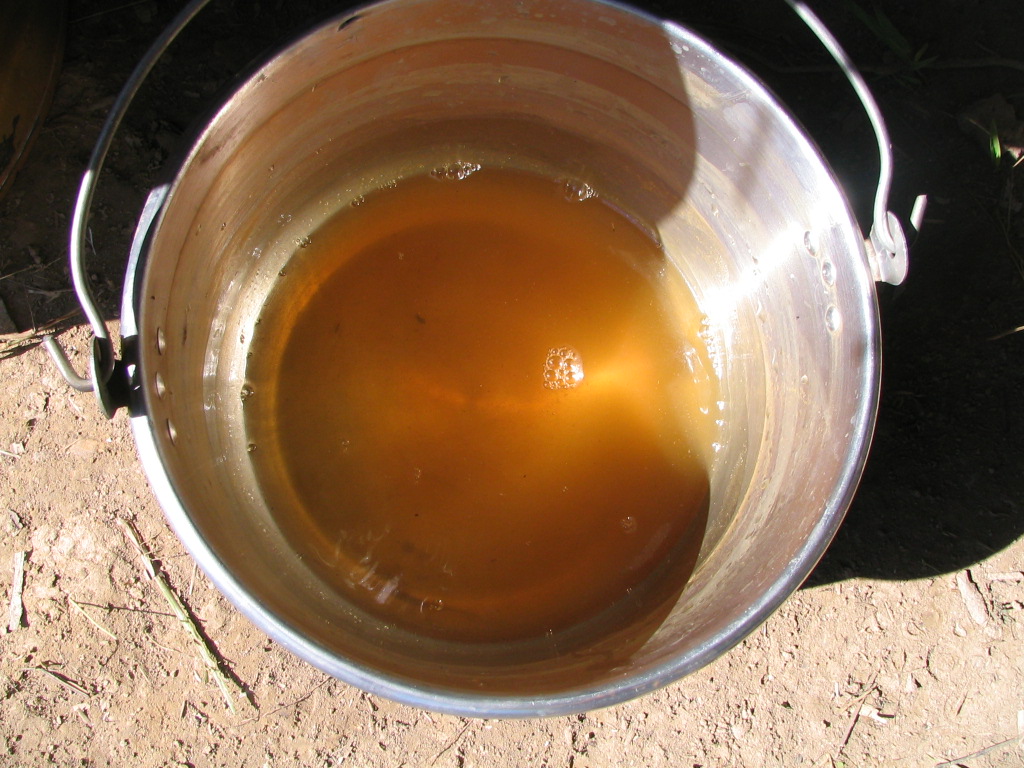
Modern technology – what would we do without it! The other day Jake needed to clean his spade after using it in the chaco. There was a bucket of water from the well sitting there so he just cleaned it in there. The next morning when he went to use the water for the plants there was no scum! The water appeared fairly clear from the magnesium and didn’t have an odor. Quite the discovery – maybe.

So he took 2 more buckets, filled them well water and let them sit in the open air for a day. The usual yucky, unattractive scum appeared. If you put a plate or a container in this water you would immediately get a reddish scum which, if you did not wash it, would stain badly. After a day, Jake took clay in which there was no humus and mixed it with the water. It sat undisturbed for another day at which time he found that the water was clear, a bit dirty but clear. We left it for another day and most of the dirt had settled to the bottom of the bucket.

When we had the water tested in Canada we were told that it was not harmful, just disgusting to look at. Now that it is clear it should be good for the people to use. We hope that they will apply this simple technology and use there wells. It was two years ago today that we came to the community to drill the wells and now we hope that they can actually use the water. We are very thankful that the solution is simple and economical.

The Garden


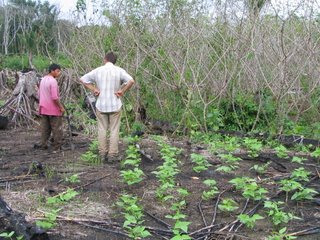
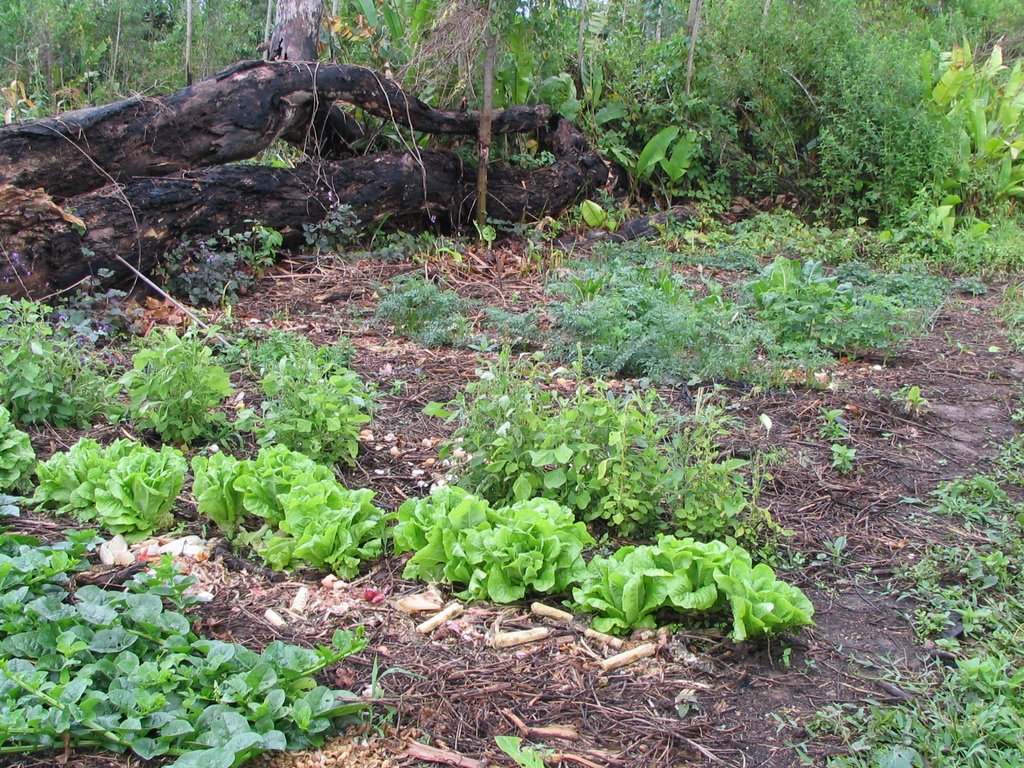
According to the people in the community we planted our garden too late. Thankfully, they didn’t look at how we seeded! Jake cleared the land with the machete and I hauled the largest trees away and pulled up the majority of the vines. The rest of the material we left and planted the seeds among the rotting leaves and weeds.

They, on the other hand, have very clean garden without many weeds since they burn everything. Theirs does look neater and cleaner but…..

In 3 months we had a wonderful garden fed by the decomposing plants and all the kitchen waste. We planted everything much closer than they would and we had great growth and production.

We received our seeds from ECHO and planted Malibar Spinach, lettuce, and lablab beans. Unlike our neighbours we leave the lettuce in the ground and only harvest the leaves. They take everything out by the root when it is ready so we hope to teach them that the length of production can be lengthened just by harvesting only the leaves. The lablab beans, used for eating and for green manure, are a great topic of converstion.

Our tomatoes are producing enough fresh tomatoes for the two of us. The are getting ripe after all the rest in the community and again we will experiment next year with succession planting. The men who work for us are amazed that the corn was planted 3 or 4 inches apart in the row and still produced wonderful ears. They plant their corn at 1 meter spacing in the row with the rows 1 meter apart. The variety we planted is an open pollinated corn from ECHO and is quite tasty. Next time we hope to plant some good American sweet corn. When we ate the first corn the men were amazed that yellow corn was so sweet!

There will be great demand for the amaranth seed since Jake has been making that for breakfast laced with butter and brown sugar. The guys love it!

So we are very pleased with our first garden and people are coming to look at it. That is exactly what we want so we hope and pray that some of our ideas for producing food throughout the year will work.