Things are ahappenin’. We arrived back from Patajusal with renewed energy and promptly told our teachers that we were planning to leave the end of April. Of course, that gave us a different attitude towards school and it took a few days to get back into the study mode. I decided that I would learn as much grammar as I could and would leave the vocabulary until we moved. I want to finish the second textbook before we go. We are fortunate that we can set our own goals. There are some missionaries that must go so school until their mission board says they are proficient enough to work in the field. Our teachers are very cooperative and are working in the areas that we need.
And we bought a truck. We had looked at vehicles before Christmas but did not make any decisions. After being in Patajusal we tried our Spanish in Santa Cruz—and we did quite well. The majority of the questions were asked and answered in Spanish and then at the end an English speaking person would come and explain the extra details and ask any questions. We found that we had comprehended most of what was said. Talk about being on Cloud Nine! We asked them to send us quotes and we would decide. In the end we bought a Chevrolet LUV diesel pick up truck. Ironically, we bought it here in Cochabamba where it was over a thousand dollars US cheaper. It is a 2005 and we think that there is a surplus of the particular model. Air conditioning has to be installed so it will be a couple of weeks before we get it.
Last weekend Jake went back to Yapacani and rented a house beginning the middle of April. We thought it would be better to have our own home base in the city rather than staying with other people all the time. I do like my privacy. So what we rented were three rooms in a row with a bathroom at the end. None of the rooms have doors into the other, so we have to walk outside to get from room to room. Pete and Linda lived in this place for about a year so we know something about the place and the landlords. We will have electricity in the rooms but the water is out in the garden area. All the rooms are simply rooms – no such thing as a kitchen. Usually a family will live in one room and share the washing facilities and the bathroom. But we are renting all three, the same as Pete and Linda did.
Jake also went back to Patajusal and found another piece of land. This one is close to the centre of the community, has a well, and is higher land. The owner is a single guy who we think has moved to Yapacani. Dienisio is going to check things out for us at the end of the month and we should know more then.
And we have found someone with whom to work. Dienisio is a good friend of Pete and Linda and was instrumental in the growth of the church in Challe Vito. He is a good farmer but has been having some serious health problems so the destiny of his farm is in question. For the last year he has been working with World Concern and has also been working with some of the small evangelical churches in the area. Although there is no established church in Patajusal, he has been working there also. He has a great enthusiasm for the Lord and for the work that we will be doing. We are so thankful for him and his wife, Viviana.
Things to pray for:
The continuation of our language studies
That the ‘right’ piece of land will be available to us
Dienisio has a wife and three girls. He has recently moved into Yapacani so that his daughters can go to school. Aside from that he has had health problems for the last couple of years. He is coughing up blood. He is gone to a number of doctors, both locally and in Santa Cruz, but they have not been able to find anything. They have tested him for both TB and chaugas. We ask that you pray that someone will be able to find out what is wrong and that he can regain his health.
Thanks for the friends and support that we have here in Cochabamba.
Sorry, guys, pics next time. Jake didn't take the camera.
Sunday, March 19, 2006

Water, Water, Everywhere
It was an impulsive decision. Maybe we should have thought about it longer. But sometimes things work out well. Such was our trip to Yapacani. We had planned to visit Yapacani and Patajusal sometime in February but the days seemed to slip by and we stayed home. Then we heard that a youth group from the Calama Baptist Church was taking a bus. After many phone calls we secured seats on the bus and quickly packed our bag. When we arrived at the appointed time there was no bus. Nothing unusual for Bolivia. Some said it would be there at 1, others said 2. In true Bolivian style we simply visited our friends until the bus came at 12:30!! Much to our surprise there were 110 kids going. Since I get car sick we were given the front seats but we were dismayed when we found that there was not enough seats for all the kids. No one else seemed concerned.
Now, if it is Bolivian vehicles, the road, or us, I do not know. Before we were 5 kilometres from town we had already stopped three times so that the bus could be ‘tuned’ up. It certainly did not have much power. A little tweaking here and a little tweaking there --things were better and we were on our way. I couldn’t help but think that we needed my nephew, Steve, to tune it up. I was looking forward to a scenic trip since we were sitting so much higher than in the car. But instead we had a very rainy view of the forest an the valleys. It still was breath taking in spite of the rain. People had told us that we should try to be at our destination before dark because there were people on the road. Ok. That sounded reasonable. But little did we think that there would be so many people. It seems as if they use the highway as their living room – many people just sit on the side of the road as vehicles fly by. Children also play on the shoulder. Now once the bus gets on the flat, it goes. We were cruising down the highway, passing a truck, when suddenly a small girl, about two years old, comes wandering on to the highway. We missed her only by the grace of God! It was as if time stood still. After that incident the driver had his hand on the horn whenever he saw anyone close to the road.
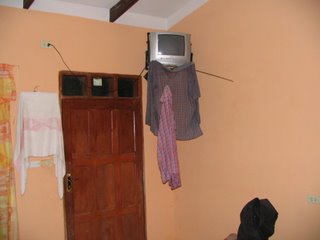 We arrived safely in Yapacani and checked into the local Hilton –not! Because there had been a lot of rain they had not been able to dry their laundry so the poor guy had to iron the sheets dry. Then we asked for an extra towel and he had to iron it dry also. The room smelled moist and dank with the odor of mould in the bedding. The importance of air movement was very relevant. So many of their homes have windows only on one side, without any cross ventilation.
We met with Nico and Hugo and made plans for the next couple of days. Sunday would be the town’s Carnival celebration so nothing would be planned for that day. They had two towns selected for us to see - Patajusal and San Sidro. We planned to go to Patajusal on Monday and San Sidro on Tuesday. Monday arrived and off we went in the Land Rover with Nico and his daughter, Joselina. The trip was going well until the lost the brakes. Sounds familiar, eh! Although Nico tried to fix them, we ended up traveling without brakes. Thankfully there were no hills and we could stop by putting the truck into neutral or by turning off the key. The only road hazard was the wash outs from the storms that happened not only in the area but also up river.
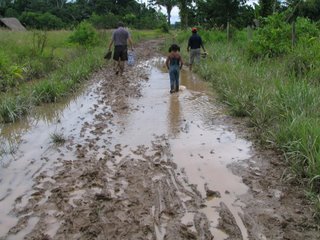 No one expected us in Patujusal. We met some of the women on the road and they were very happy to see us. Estephania and her children rode with us from Patajusal 1 to Patajusal 2. We arrived at Patajusal 2 to find that we could not drive into the community. Friday night and Saturday had brought them the seventh flood of the season. The water arrived during the night from the river and it had flooded the road and many of their houses and yards. However, the
  people took it all in stride and were busy harvesting their rice. During the couple of hours we were there we could see that the water was going away and the road was becoming more solid. So we walked in. The first kilometer was fairly easy going but then we started to come to the lower spots. Soon off came the shoes and we walked – slip and slide – through the greasy clay-like mud. Jake carried one of the children and I carried our stuff.
Finally we arrived at the house of Valentina, the pre sident of the community. Nico stood at the end of the road and called. Soon the children came, telling us that their parents were harvesting rice. “Go tell them Margarita and Jacobo are here.” Off they went and a while later Valentina, Zacharius and our good friend, Guermo, came in from the fields. After talking for a while they had a get back to their harvesting so we went along and harvested some rice by hand. Now if we had to do the field by ourselves I am not sure that it would be done. It is a slow process and I have nothing but respect for those who do it, all with a knife.
After enjoying fresh lemonade we headed back to the truck. But first Nico had to show us one of the pieces of land that is for sale. It is a very low piece and was covered in water. He also showed us another piece in Patajusal 1 that is cleared and has a small homestead on it. It has water and was not flooded. We are having a difficult time deciding what we should do since each one has its advantages and disadvantages. We plan to return to the community and look at
them again before we make any decisions. I came back very discouraged – the length of time it took to drive to the community, the flooding, and the feeling that it seemed so hopeless. Thankfully, the next day we visited with some other friends. After talking to them I was in much better spirits and felt even more strongly that we would move there – and that it would be all right.
 So what did we learn from the trip?
• We can manage with our Spanish, even though it is not very good.
• There is a huge need for assistance in Patujusal
• There is a great group of people that are looking forward to us coming and are willing to help us.
• That Jake is very eager to move on.
• That, thank God, we don’t make these decisions on our own.
Now, if it is Bolivian vehicles, the road, or us, I do not know. Before we were 5 kilometres from town we had already stopped three times so that the bus could be ‘tuned’ up. It certainly did not have much power. A little tweaking here and a little tweaking there --things were better and we were on our way. I couldn’t help but think that we needed my nephew, Steve, to tune it up. I was looking forward to a scenic trip since we were sitting so much higher than in the car. But instead we had a very rainy view of the forest an the valleys. It still was breath taking in spite of the rain. People had told us that we should try to be at our destination before dark because there were people on the road. Ok. That sounded reasonable. But little did we think that there would be so many people. It seems as if they use the highway as their living room – many people just sit on the side of the road as vehicles fly by. Children also play on the shoulder. Now once the bus gets on the flat, it goes. We were cruising down the highway, passing a truck, when suddenly a small girl, about two years old, comes wandering on to the highway. We missed her only by the grace of God! It was as if time stood still. After that incident the driver had his hand on the horn whenever he saw anyone close to the road.
 We arrived safely in Yapacani and checked into the local Hilton –not! Because there had been a lot of rain they had not been able to dry their laundry so the poor guy had to iron the sheets dry. Then we asked for an extra towel and he had to iron it dry also. The room smelled moist and dank with the odor of mould in the bedding. The importance of air movement was very relevant. So many of their homes have windows only on one side, without any cross ventilation.
We met with Nico and Hugo and made plans for the next couple of days. Sunday would be the town’s Carnival celebration so nothing would be planned for that day. They had two towns selected for us to see - Patajusal and San Sidro. We planned to go to Patajusal on Monday and San Sidro on Tuesday. Monday arrived and off we went in the Land Rover with Nico and his daughter, Joselina. The trip was going well until the lost the brakes. Sounds familiar, eh! Although Nico tried to fix them, we ended up traveling without brakes. Thankfully there were no hills and we could stop by putting the truck into neutral or by turning off the key. The only road hazard was the wash outs from the storms that happened not only in the area but also up river.
 No one expected us in Patujusal. We met some of the women on the road and they were very happy to see us. Estephania and her children rode with us from Patajusal 1 to Patajusal 2. We arrived at Patajusal 2 to find that we could not drive into the community. Friday night and Saturday had brought them the seventh flood of the season. The water arrived during the night from the river and it had flooded the road and many of their houses and yards. However, the
 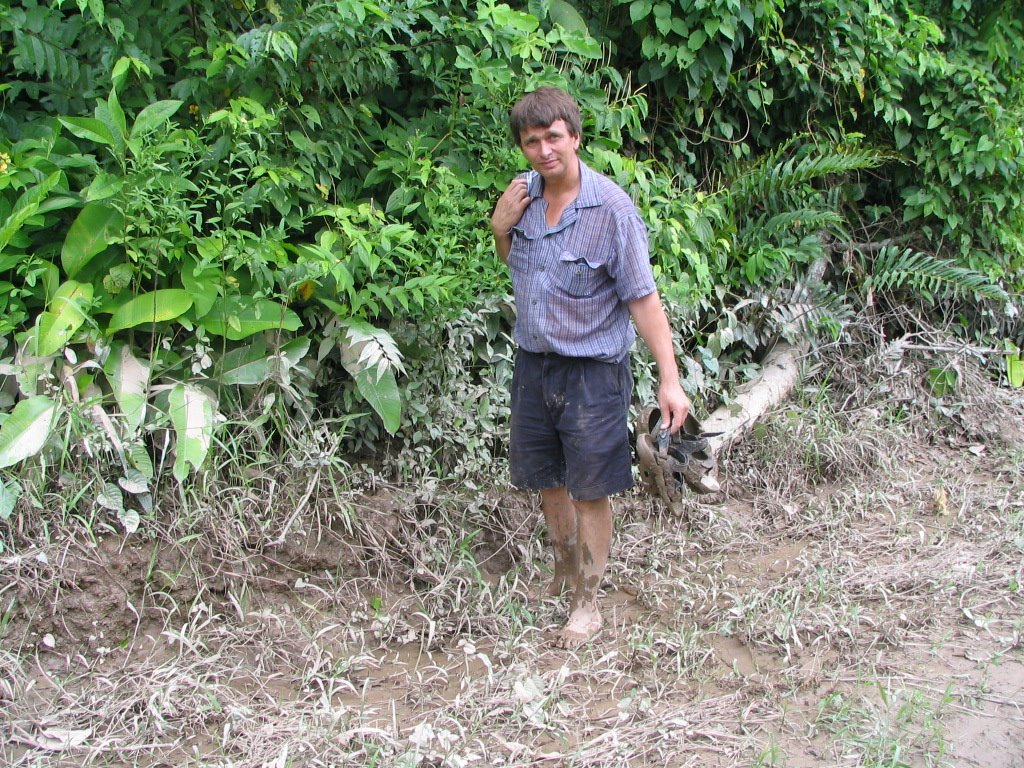 people took it all in stride and were busy harvesting their rice. During the couple of hours we were there we could see that the water was going away and the road was becoming more solid. So we walked in. The first kilometer was fairly easy going but then we started to come to the lower spots. Soon off came the shoes and we walked – slip and slide – through the greasy clay-like mud. Jake carried one of the children and I carried our stuff.
Finally we arrived at the house of Valentina, the pre
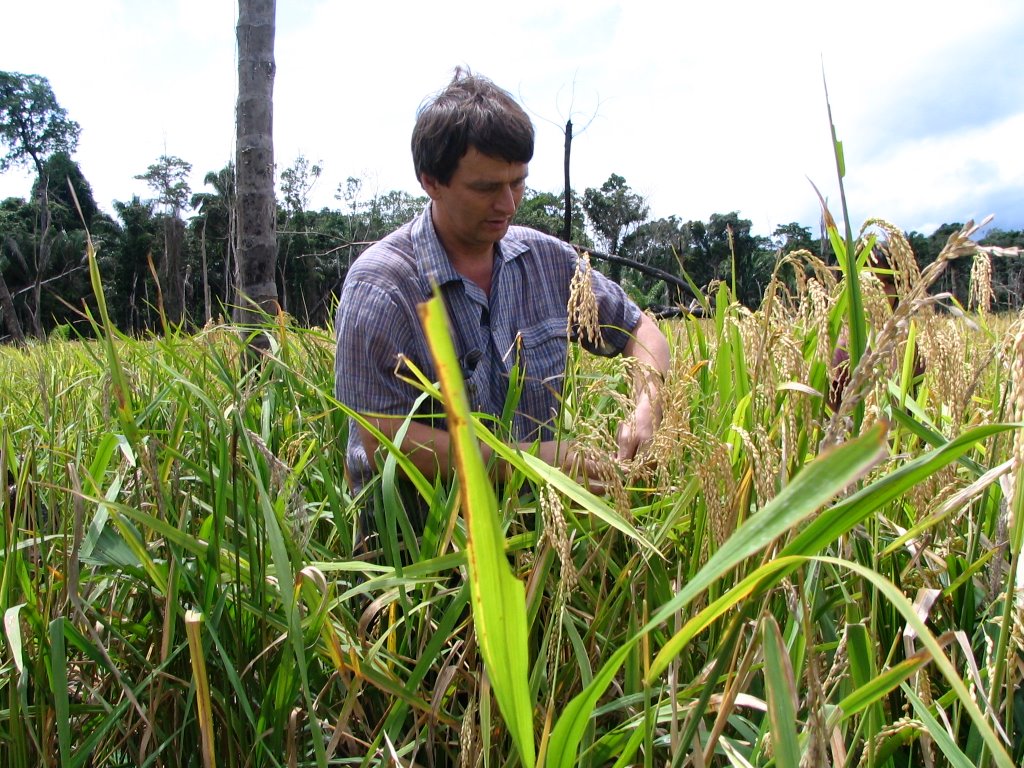 sident of the community. Nico stood at the end of the road and called. Soon the children came, telling us that their parents were harvesting rice. “Go tell them Margarita and Jacobo are here.” Off they went and a while later Valentina, Zacharius and our good friend, Guermo, came in from the fields. After talking for a while they had a get back to their harvesting so we went along and harvested some rice by hand. Now if we had to do the field by ourselves I am not sure that it would be done. It is a slow process and I have nothing but respect for those who do it, all with a knife.
After enjoying fresh lemonade we headed back to
 the truck. But first Nico had to show us one of the pieces of land that is for sale. It is a very low piece and was covered in water. He also showed us another piece in Patajusal 1 that is cleared and has a small homestead on it. It has water and was not flooded. We are having a difficult time deciding what we should do since each one has its advantages and disadvantages. We plan to return to the community and look at
them again before we make any decisions. I came back very discouraged – the length of time it took to drive to the community, the flooding, and the feeling that it seemed so hopeless. Thankfully, the next day we visited with some other friends. After talking to them I was in much better spirits and felt even more strongly that we would move there – and that it would be all right.
 So what did we learn from the trip?
• We can manage with our Spanish, even though it is not very good.
• There is a huge need for assistance in Patujusal
• There is a great group of people that are looking forward to us coming and are willing to help us.
• That Jake is very eager to move on.
• That, thank God, we don’t make these decisions on our own.
Saturday, February 18, 2006
To Canada and back again
We went back home to Canada in mid January. Who in their right mind would choose the middle of January to go to Alberta? Before we headed home we stopped off in Iowa to celebrate Jake’s parents’ 60th wedding anniversary in Sioux Center. We spent a few enjoyable days there with Jake’s brother and sister-in-law. We were very thankful that Kurt, Sherry Ann and Sophia, along with Tim were able to join us. KerryAnne and the children were not able to come due to illness.
We had some quick adjustments to make. We could deposit the toilet paper in the toilet and flush it away. It took a few times looking for a garbage can before we fell back into the usual habit. We could also take showers with lots of water and still get a hot shower.
The three vehicles traveled back to Canada together and we did encounter a storm in North Dakota and southern Saskatchewan. With five drivers and three vehicles we were able to make it home in good time, considering the weather.
We spent the time visiting children and grandchildren and were honored to celebrate the birthdays of our oldest granddaughter, Karmen, who turned 18 and her little sister, Sophia, who turned one. Jake had to spend a lot of time tying up loose ends for the business and I had a chance to meet with a number of girlfriends for a scrap booking day. I was honored that my niece took a personal day so that we could spend some time together. It was a busy time and we learned that a week certainly was not long enough. It will take some time before we know what the right length of time is.
And about the weather – it was gorgeous. I never wore a heavy jacket once and the temperature remained about 0 C. the whole time. We couldn’t have had it better.
We headed back to Bolivia laden with luggage. We took the maximum back that we could, along with a new computer for the radio ministry. We landed in Santa Cruz without mishap, and although we do not normally hire a porter, we did this time. That made going through customs much quicker. Waiting for us was our good friend, Jake Fehr. It was his computer. He was like a little kid in a candy store with his new toy. We are thankful that we were able to take it along since it will make his life much easier. The Fehr’s persuaded us to stay in Santa Cruz for a couple of days. We planned to go to San Julian but that never did materialize. Instead we spent some very enjoyable days getting to know the new members of the EEFCM team, Rudy and Erna Friesen. As well we did some shopping to look at the availability of solar equipment and things that we would need when we move to Yapacani.
We agreed to stay in Santa Cruz but there was a problem. We left here with only one set of clothes since we knew that we would not wear shorts in Canada. So when we came back we had only one set of clothes to last us a week! No problem, there is a used clothes market and you can get some clothes there. Rudy and Erna want to go to so it would be a good time to get to know each other. So off the five of us went. We took the maid along in case we had problems. And what a market. It was about a mile long and four aisles wide filled with used clothing. Of course, we loved it because we saw good bargains. But to think that all of it was cast offs from North America was overwhelming. Most of the clothes cost around $1 to $2. They are purchased by the bale and then sold. Jake asked the price of a bale (about 100 lbs.) and it was $20.00. We are not sure how things can be done that cheaply but sometimes it is better not to ask.
We spent the weekend at the radio station and while we were there the Rio Grande started to overflow. That means that is took another route. The ground is very sandy and the river has no banks so often it simply diverts through an easier route. The town of Pailon has dykes built around it but a dyke broke further upstream. The town itself was not affected but a lot of land was under a meter of water. It was also reported that further north the people were on the road since it was the only high spot. They said the rain came from Cochabamba rather than from rain falling in that area. With all the rain we have had in the past week, I am sure that there is even more flooding.
We submitted the paperwork for our visas on Monday and then headed back to Cochabamba on Tuesday. And back to school on Wednesday.
Since we returned, we have had two new additions to our house. One is Finian’s cat, Gatto, and the other is his new brother. Aiden Philip was born just after midnight on Feb. 7. By noon he was at home being spoiled by his grandparents who were visiting from England.
So now life goes back to normal, whatever that is. Although we first thought (idealistically) that we would now enough Spanish but the end of February, and then the end of March, we have decided that we will be here at least until the end of April. I am not willing to head out into the community without a good grasp of the language since there will be no one there to rescue us if we don’t understand. So we have made ourselves at home, hung up the family pictures, and settled in.
Until next time.
We had some quick adjustments to make. We could deposit the toilet paper in the toilet and flush it away. It took a few times looking for a garbage can before we fell back into the usual habit. We could also take showers with lots of water and still get a hot shower.
The three vehicles traveled back to Canada together and we did encounter a storm in North Dakota and southern Saskatchewan. With five drivers and three vehicles we were able to make it home in good time, considering the weather.
We spent the time visiting children and grandchildren and were honored to celebrate the birthdays of our oldest granddaughter, Karmen, who turned 18 and her little sister, Sophia, who turned one. Jake had to spend a lot of time tying up loose ends for the business and I had a chance to meet with a number of girlfriends for a scrap booking day. I was honored that my niece took a personal day so that we could spend some time together. It was a busy time and we learned that a week certainly was not long enough. It will take some time before we know what the right length of time is.
And about the weather – it was gorgeous. I never wore a heavy jacket once and the temperature remained about 0 C. the whole time. We couldn’t have had it better.
We headed back to Bolivia laden with luggage. We took the maximum back that we could, along with a new computer for the radio ministry. We landed in Santa Cruz without mishap, and although we do not normally hire a porter, we did this time. That made going through customs much quicker. Waiting for us was our good friend, Jake Fehr. It was his computer. He was like a little kid in a candy store with his new toy. We are thankful that we were able to take it along since it will make his life much easier. The Fehr’s persuaded us to stay in Santa Cruz for a couple of days. We planned to go to San Julian but that never did materialize. Instead we spent some very enjoyable days getting to know the new members of the EEFCM team, Rudy and Erna Friesen. As well we did some shopping to look at the availability of solar equipment and things that we would need when we move to Yapacani.
We agreed to stay in Santa Cruz but there was a problem. We left here with only one set of clothes since we knew that we would not wear shorts in Canada. So when we came back we had only one set of clothes to last us a week! No problem, there is a used clothes market and you can get some clothes there. Rudy and Erna want to go to so it would be a good time to get to know each other. So off the five of us went. We took the maid along in case we had problems. And what a market. It was about a mile long and four aisles wide filled with used clothing. Of course, we loved it because we saw good bargains. But to think that all of it was cast offs from North America was overwhelming. Most of the clothes cost around $1 to $2. They are purchased by the bale and then sold. Jake asked the price of a bale (about 100 lbs.) and it was $20.00. We are not sure how things can be done that cheaply but sometimes it is better not to ask.
We spent the weekend at the radio station and while we were there the Rio Grande started to overflow. That means that is took another route. The ground is very sandy and the river has no banks so often it simply diverts through an easier route. The town of Pailon has dykes built around it but a dyke broke further upstream. The town itself was not affected but a lot of land was under a meter of water. It was also reported that further north the people were on the road since it was the only high spot. They said the rain came from Cochabamba rather than from rain falling in that area. With all the rain we have had in the past week, I am sure that there is even more flooding.
We submitted the paperwork for our visas on Monday and then headed back to Cochabamba on Tuesday. And back to school on Wednesday.
Since we returned, we have had two new additions to our house. One is Finian’s cat, Gatto, and the other is his new brother. Aiden Philip was born just after midnight on Feb. 7. By noon he was at home being spoiled by his grandparents who were visiting from England.
So now life goes back to normal, whatever that is. Although we first thought (idealistically) that we would now enough Spanish but the end of February, and then the end of March, we have decided that we will be here at least until the end of April. I am not willing to head out into the community without a good grasp of the language since there will be no one there to rescue us if we don’t understand. So we have made ourselves at home, hung up the family pictures, and settled in.
Until next time.
GARDENING IN COCH
O.K. is has been over a month and no blog entries. What happened? First we move our home in Cochabamba. We now live only three blocks from the language school. It is nice getting up later but we do miss the walks. And for some reason we just have not been able to fit them in again. But there are advantages to living here. We are a twenty minute walk from downtown and the church and a fifteen minute walk to the supermarket. The outdoor market takes place each Saturday at the end of the street and there is a permanent market just a couple blocks away.
We also have a yard in which we can work. I have enjoyed it but I would not want to year- round garden the garden I had at home. This one is enough work but then it has been untended for awhile. Around the edge of the lawn is a row about 50 cm. wide of Lamb’s Ear. It looks quite attractive except for all the oxalis and some type of small lily that is growing through it. The first time I had no tools so I simply took everything off at ground level. Now I have a trowel and have been trying to get out all the corms. I am sure that I have unearthed over a thousand. And to think that we sold those for money at the garden centre!! I have added some alyssum, gazania, and impatiens to make the garden more colorful. Now we have had a lot of rain so things are growing well.
We have had a lot of rain in the past month but if we don’t have rain we have to water every day. That is something that I did not expect. But the soil does not retain water well and dries out very quickly. A day after a good rain and I can back weeding.
Jake and Pete have a greenhouse on the space right in front of our bedroom window. It is a space that was designed for vehicles but since we don’t have one, and that is the only space with good sunlight, it was made into a greenhouse. It is right along the street and I am sure that the locals thought that those gringos were loco. But now that things are growing, they are quite fascinated and stop to see what is new. Jake has planted a bed of Moringa seeds and that seems to be the most fascinating. They also have tomatoes in the greenhouse. Behind the house there are tomatoes and peppers and we are eating the fresh lettuce. Eat your hearts out!
It is good to have this place to call our own for a few months. In the afternoon when I am tired I go out and work in the garden for an hour or two and it does more good that a nap. I am not sure what changes will take place in a couple of months but it is giving us some experience in somewhat tropical gardening.
We also have a yard in which we can work. I have enjoyed it but I would not want to year- round garden the garden I had at home. This one is enough work but then it has been untended for awhile. Around the edge of the lawn is a row about 50 cm. wide of Lamb’s Ear. It looks quite attractive except for all the oxalis and some type of small lily that is growing through it. The first time I had no tools so I simply took everything off at ground level. Now I have a trowel and have been trying to get out all the corms. I am sure that I have unearthed over a thousand. And to think that we sold those for money at the garden centre!! I have added some alyssum, gazania, and impatiens to make the garden more colorful. Now we have had a lot of rain so things are growing well.
We have had a lot of rain in the past month but if we don’t have rain we have to water every day. That is something that I did not expect. But the soil does not retain water well and dries out very quickly. A day after a good rain and I can back weeding.
Jake and Pete have a greenhouse on the space right in front of our bedroom window. It is a space that was designed for vehicles but since we don’t have one, and that is the only space with good sunlight, it was made into a greenhouse. It is right along the street and I am sure that the locals thought that those gringos were loco. But now that things are growing, they are quite fascinated and stop to see what is new. Jake has planted a bed of Moringa seeds and that seems to be the most fascinating. They also have tomatoes in the greenhouse. Behind the house there are tomatoes and peppers and we are eating the fresh lettuce. Eat your hearts out!
It is good to have this place to call our own for a few months. In the afternoon when I am tired I go out and work in the garden for an hour or two and it does more good that a nap. I am not sure what changes will take place in a couple of months but it is giving us some experience in somewhat tropical gardening.
Sunday, January 01, 2006
Travel - Bolivian style
Another year has passed and it is time for both reflection on the past year and hope and anticipation for the new. The last year has been a time for change, for growth, for challenge. Much the same is anticipated for the next year and we are grateful that we are able to look forward in faith to what we are doing.
Our Christmas was certainly not spent in the same way we did in the past. Without the cold and snow it just wasn’t the same. We planned to leave Cochabamba by bus and travel to Yapacani. There we were to meet up with Pete and Linda, travel to the community of Challevito and spend Christmas there. We planned to visit our friends in Patajusal, as well as meet with the people from CEPY with whom we worked last year. It is a good thing that we are becoming Bolivian and, therefore, used to great changes in plans.
The bus companies decided in their great wisdom that it would be a good time to stop service for a couple days before Christmas. The busses and transportation trucks were told by the government that they were to pay taxes. The trucks complied but the busses have not. So, another order came down and, in response, the busses did not run the Wednesday and Thursday before Christmas. So that was one part of the story. The other was that Finian, Pete and Linda’s 18-month-old son took a tumble from steps and broke his leg. He is in a cast from his waist down so is fairly immobile. Pete and Linda traveled with him to Santa Cruz and decided it was better to stay there rather than return the community. Pete made arrangements to meet us back in Yapacani so we wanted to be there. But how? Fly. A trip to the airport only to find that the planes for the day were filled and they would not let us buy a ticket for the evening flight until an hour before the flight left. I wasn’t comfortable with that solution since I was not convinced there would be tickets and we would get into Santa Cruz late at night, with a two hour taxi ride to Yapacani ahead of us. A friend, Fredrico, was helping us and we were in his brother’s taxi. Jake and I had joked before about taking a taxi so we asked if he would be willing to take us to Yapacani. After some discussion, he agreed. Now this is a 6 to 8 hour ride one-way, depending on the roads. You have to understand the Cochabamba taxis. Most of them are used Japanese imports that have been transformed into taxis. The steering column has been removed from the left side of the vehicle and installed on the right side. The control panel, if it works, is still on the left hand side. Then they convert it from gasoline to natural gas since natural gas is much cheaper. Now you have a Cochabamba taxi. The other thing to understand is that Cochabamba is in a valley, surrounded by mountains. The inclines are great and the roads certainly do not meet North American standards. When there is rain, there are mudslides and there had been rain the previous week so much the road had been recently cleared – at least one lane was clear. For the Canadians that know the Fraser Canyon, that would be the closest I was think of. Now put the road from Edzo to Yellowknife going down the canyon and you would have somewhat of an idea of what it was like.
So just after lunch we head off. Before we left we all prayed together for a safe trip. We travel through the outskirts of Cochabamba and stop at the first town. Frans gets out with a bundle of papers and trots off to a checkpoint. You must get permission from the local constabulary before you can proceed. They check the papers and his license, collect the tax and we are on our way. The country is gorgeous. We are very high but the mountains are still covered with grass and trees. Farms are scattered along the hillsides and we see the farmers out working in their fields with the oxen and plows. Soon we stop. Maybe he is stopping so that we can take a picture. No, the controls on the car do work and it is evident that the engine is heating up. This car is not meant to be going up these hills! Being prepared, Frans has brought along extra water and they refill the radiator, wait a few minutes and proceed. We have been on the road for an hour, travelling through beautiful country but I realize that we have only gone 20 kilometers. The scenery gradually changes and we enter the rainforest. This is also very mountainous country and there is very little civilization. We watch the heat gauge and we are managing that. We get to the top on an incline and Frans pulls over once again. There are a number of trucks stopped at the same place and the small shack on the side of the road indicates that is store that sells oil etc. for vehicles. Frans and Fredrico get out and check the tires. They look fine to us but the problem is not the tire. The brake has seized, the brake pads are totally worn out, the drum is sizzling hot. I am sure we could have fried eggs on it. Thankfully, one of the truckers takes it apart. The line needs to be plugged so that we do not lose the brake fluid. Frans and Fredrico are going to put a piece of plastic around it but Jake gets a small piece of wood to plug the hole. The brake is reassembled, minus brake pads, and off we go. I am wondering if we should go back over the mountains we have already come or forward into the ones we don’t know. Frans and Fredrico don’t seem that concerned and off we go. Did I tell you that every time we stop the car it takes two or three tries to get it started? We enjoy a few more miles of scenery. Think also that there are a fair number of trucks on the road so we pass them on these wonderful mountain roads. As we were passing one, Frans veered off to the side (thankfully toward the mountain!). The brake had gone again, or rather the brake fluid has leaked out so we are without brakes. From then on, he managed control the speed using the gearshift and the emergency brake. At one point a new highway was being built. First they level out the existing road. Loads of stones, gravel and sand are dropped along the road. Then they manually load the stones into wheelbarrows, place them on the road, and level it off with gravel and sand. When all this prep work is done, they take cement and pour in over top and trowel it all by hand. When the road is finished they place large rocks on top so that people cannot drive on it until the cement is cured. Then they take off all the rocks and the road is ready to use. If I had known what was happening, I would have taken pictures of the whole operation. Next time. Frans was a very careful driver, but I also believe that faith, prayer and God’s guidance brought us through. Soon after we left the mountains we arrived at a small town and spotted a garage. Within a half an hour we had brand new brake pads and we were on our way down a paved highway for the rest of the trip. It seemed very uneventful after the mountains.
We arrived at our little hotel in Yapacani at 8:30, three hours later than we had planned. We walked in and greeting the young man at the desk. He looked at us, pulled out his book and started paging through it, virtually ignoring us. Soon he came to a page, looked at us with a big smile, and pointed to our names from last year! We were amazed – and impressed! We were now friends and we didn’t have to fill anything in. There was only one room left – with three double beds. We planned on taking Frans and Fredrico out for supper before they headed back and this time it seemed like the car had given up. It wouldn’t even turn over. After some fiddling, it started once again and the guys were safely back in Cochabamba at 5:30 the next morning.
We started the next day by phoning Nico and making arrangements to meet him. With our limited Spanish we made plans. Pete came at 9 and we headed off to the CEPY office. We spent the morning discussing the future of CEPY, what is wants to do and where it is headed. It has reached a crossroads in its existence and has to reevaluate its purpose and mission. They would like to continue to work but realize that they have not been as effective as they could be. We also told them what we would like to do and asked advice on our plans. It became obvious that they did not want people simply to come from the city and tell them what to do or how to do it. If we plan to living in the community we would be welcome but not if we were only coming ‘from the city’. They also were quite strong that the relationship with the people was the most important part of development. I was very appreciative of their honesty. We plan to return in February and have another meeting. I will review their constitution and structural plan and they are going to look for communities and land within those communities. It still seems like Patajusal is the best choice but we want to make sure. We planned to go to Patajusal on Saturday but it rained Friday night. The Land rover was not working and they did not think that the motorbike would make it through the sand. So we didn’t go. That is another February visit. It would have been good to see the people there but this way they won’t have their hopes up already.
Instead we spent the morning with Nico and his family and then traveled to Santa Cruz. We booked into our usual hotel and enjoyed the air conditioning. In the evening we attended the Christmas service for the International Church, the English speaking church in Santa Cruz. We met some of these people last year so it was not entirely new. We knew that Jake and Dorothy Fehr attended that church but were not sure that they would be there since Jake planned to be on air at the radio station in Pailon all day Sunday. We sat in the back with Linda and Finian – and his cast. After the service we were talking and a couple came up to us. It was Jake and Dorothy. They were very good to us and took us along to a Bolivian Christmas at one of their friends. It was a good time – good food, good people, and a lot of fire works and fire crackers. Singing Christmas songs in church made it seem somewhat Christmasy but spending the evening sitting outside with fireworks reminded me of the American July 4 we spent in Sioux Falls. The next day we spent with Bill and Heidi Janeke. They work with the Christian Veterinary Mission and World Concern. It was a relaxing day and we were very thankful to all of them for including us in their day. That night we moved into the South American Mission Guesthouse and stayed there for the rest of the week. From there we were able to scout out the city, check prices on things, and see what was available in Santa Cruz. On Wednesday we headed out to Pailon to Radio Trans Mundial. It was a fantastic experience, seeing the station, seeing new country, and meeting new friends. We felt very much at home with Jake and Dorothy and their friends. And I even got to see some Corner Gas episodes!! Back in Santa Cruz we spent more time looking, planning and thinking. Thanks to Jake Fehr (working with two Jakes is a challenge!) we were able to scout out some vehicles although we did not buy one.
So we now start a new year. We are so thankful for:
*The support of our families. This includes our sons, daughters in law, and grandchildren; our brothers, sisters, nieces, and nephews, our parents.
*The opportunity to work with Evangelical Free Church of Canada Mission, for their vision and their openness to let us explore God’s world and our place in it
*For the members of our team: for Jake and Dorothy, Steve and Myra
*For the wonderful support and friendship of Pete, Linda and Finian
*For the support of the people back home and all those who support us through finances and prayers
*For our language school, our teachers, and their understanding of our needs; for the rest of the students and their constant support with our studies
*For the intricate communication networks that we are able to use to keep in contact *The opportunity to celebrate Jake’s parents’ 60th wedding anniversary in January and spending some time with our children and grandchildren
*The witness we are able to give to the people we know in Canada and US and to the people were getting to know in Bolivia
*Our great Savior and Lord who holds us all each day, every hour in his hand.
Our Christmas was certainly not spent in the same way we did in the past. Without the cold and snow it just wasn’t the same. We planned to leave Cochabamba by bus and travel to Yapacani. There we were to meet up with Pete and Linda, travel to the community of Challevito and spend Christmas there. We planned to visit our friends in Patajusal, as well as meet with the people from CEPY with whom we worked last year. It is a good thing that we are becoming Bolivian and, therefore, used to great changes in plans.
The bus companies decided in their great wisdom that it would be a good time to stop service for a couple days before Christmas. The busses and transportation trucks were told by the government that they were to pay taxes. The trucks complied but the busses have not. So, another order came down and, in response, the busses did not run the Wednesday and Thursday before Christmas. So that was one part of the story. The other was that Finian, Pete and Linda’s 18-month-old son took a tumble from steps and broke his leg. He is in a cast from his waist down so is fairly immobile. Pete and Linda traveled with him to Santa Cruz and decided it was better to stay there rather than return the community. Pete made arrangements to meet us back in Yapacani so we wanted to be there. But how? Fly. A trip to the airport only to find that the planes for the day were filled and they would not let us buy a ticket for the evening flight until an hour before the flight left. I wasn’t comfortable with that solution since I was not convinced there would be tickets and we would get into Santa Cruz late at night, with a two hour taxi ride to Yapacani ahead of us. A friend, Fredrico, was helping us and we were in his brother’s taxi. Jake and I had joked before about taking a taxi so we asked if he would be willing to take us to Yapacani. After some discussion, he agreed. Now this is a 6 to 8 hour ride one-way, depending on the roads. You have to understand the Cochabamba taxis. Most of them are used Japanese imports that have been transformed into taxis. The steering column has been removed from the left side of the vehicle and installed on the right side. The control panel, if it works, is still on the left hand side. Then they convert it from gasoline to natural gas since natural gas is much cheaper. Now you have a Cochabamba taxi. The other thing to understand is that Cochabamba is in a valley, surrounded by mountains. The inclines are great and the roads certainly do not meet North American standards. When there is rain, there are mudslides and there had been rain the previous week so much the road had been recently cleared – at least one lane was clear. For the Canadians that know the Fraser Canyon, that would be the closest I was think of. Now put the road from Edzo to Yellowknife going down the canyon and you would have somewhat of an idea of what it was like.
So just after lunch we head off. Before we left we all prayed together for a safe trip. We travel through the outskirts of Cochabamba and stop at the first town. Frans gets out with a bundle of papers and trots off to a checkpoint. You must get permission from the local constabulary before you can proceed. They check the papers and his license, collect the tax and we are on our way. The country is gorgeous. We are very high but the mountains are still covered with grass and trees. Farms are scattered along the hillsides and we see the farmers out working in their fields with the oxen and plows. Soon we stop. Maybe he is stopping so that we can take a picture. No, the controls on the car do work and it is evident that the engine is heating up. This car is not meant to be going up these hills! Being prepared, Frans has brought along extra water and they refill the radiator, wait a few minutes and proceed. We have been on the road for an hour, travelling through beautiful country but I realize that we have only gone 20 kilometers. The scenery gradually changes and we enter the rainforest. This is also very mountainous country and there is very little civilization. We watch the heat gauge and we are managing that. We get to the top on an incline and Frans pulls over once again. There are a number of trucks stopped at the same place and the small shack on the side of the road indicates that is store that sells oil etc. for vehicles. Frans and Fredrico get out and check the tires. They look fine to us but the problem is not the tire. The brake has seized, the brake pads are totally worn out, the drum is sizzling hot. I am sure we could have fried eggs on it. Thankfully, one of the truckers takes it apart. The line needs to be plugged so that we do not lose the brake fluid. Frans and Fredrico are going to put a piece of plastic around it but Jake gets a small piece of wood to plug the hole. The brake is reassembled, minus brake pads, and off we go. I am wondering if we should go back over the mountains we have already come or forward into the ones we don’t know. Frans and Fredrico don’t seem that concerned and off we go. Did I tell you that every time we stop the car it takes two or three tries to get it started? We enjoy a few more miles of scenery. Think also that there are a fair number of trucks on the road so we pass them on these wonderful mountain roads. As we were passing one, Frans veered off to the side (thankfully toward the mountain!). The brake had gone again, or rather the brake fluid has leaked out so we are without brakes. From then on, he managed control the speed using the gearshift and the emergency brake. At one point a new highway was being built. First they level out the existing road. Loads of stones, gravel and sand are dropped along the road. Then they manually load the stones into wheelbarrows, place them on the road, and level it off with gravel and sand. When all this prep work is done, they take cement and pour in over top and trowel it all by hand. When the road is finished they place large rocks on top so that people cannot drive on it until the cement is cured. Then they take off all the rocks and the road is ready to use. If I had known what was happening, I would have taken pictures of the whole operation. Next time. Frans was a very careful driver, but I also believe that faith, prayer and God’s guidance brought us through. Soon after we left the mountains we arrived at a small town and spotted a garage. Within a half an hour we had brand new brake pads and we were on our way down a paved highway for the rest of the trip. It seemed very uneventful after the mountains.
We arrived at our little hotel in Yapacani at 8:30, three hours later than we had planned. We walked in and greeting the young man at the desk. He looked at us, pulled out his book and started paging through it, virtually ignoring us. Soon he came to a page, looked at us with a big smile, and pointed to our names from last year! We were amazed – and impressed! We were now friends and we didn’t have to fill anything in. There was only one room left – with three double beds. We planned on taking Frans and Fredrico out for supper before they headed back and this time it seemed like the car had given up. It wouldn’t even turn over. After some fiddling, it started once again and the guys were safely back in Cochabamba at 5:30 the next morning.
We started the next day by phoning Nico and making arrangements to meet him. With our limited Spanish we made plans. Pete came at 9 and we headed off to the CEPY office. We spent the morning discussing the future of CEPY, what is wants to do and where it is headed. It has reached a crossroads in its existence and has to reevaluate its purpose and mission. They would like to continue to work but realize that they have not been as effective as they could be. We also told them what we would like to do and asked advice on our plans. It became obvious that they did not want people simply to come from the city and tell them what to do or how to do it. If we plan to living in the community we would be welcome but not if we were only coming ‘from the city’. They also were quite strong that the relationship with the people was the most important part of development. I was very appreciative of their honesty. We plan to return in February and have another meeting. I will review their constitution and structural plan and they are going to look for communities and land within those communities. It still seems like Patajusal is the best choice but we want to make sure. We planned to go to Patajusal on Saturday but it rained Friday night. The Land rover was not working and they did not think that the motorbike would make it through the sand. So we didn’t go. That is another February visit. It would have been good to see the people there but this way they won’t have their hopes up already.
Instead we spent the morning with Nico and his family and then traveled to Santa Cruz. We booked into our usual hotel and enjoyed the air conditioning. In the evening we attended the Christmas service for the International Church, the English speaking church in Santa Cruz. We met some of these people last year so it was not entirely new. We knew that Jake and Dorothy Fehr attended that church but were not sure that they would be there since Jake planned to be on air at the radio station in Pailon all day Sunday. We sat in the back with Linda and Finian – and his cast. After the service we were talking and a couple came up to us. It was Jake and Dorothy. They were very good to us and took us along to a Bolivian Christmas at one of their friends. It was a good time – good food, good people, and a lot of fire works and fire crackers. Singing Christmas songs in church made it seem somewhat Christmasy but spending the evening sitting outside with fireworks reminded me of the American July 4 we spent in Sioux Falls. The next day we spent with Bill and Heidi Janeke. They work with the Christian Veterinary Mission and World Concern. It was a relaxing day and we were very thankful to all of them for including us in their day. That night we moved into the South American Mission Guesthouse and stayed there for the rest of the week. From there we were able to scout out the city, check prices on things, and see what was available in Santa Cruz. On Wednesday we headed out to Pailon to Radio Trans Mundial. It was a fantastic experience, seeing the station, seeing new country, and meeting new friends. We felt very much at home with Jake and Dorothy and their friends. And I even got to see some Corner Gas episodes!! Back in Santa Cruz we spent more time looking, planning and thinking. Thanks to Jake Fehr (working with two Jakes is a challenge!) we were able to scout out some vehicles although we did not buy one.
So we now start a new year. We are so thankful for:
*The support of our families. This includes our sons, daughters in law, and grandchildren; our brothers, sisters, nieces, and nephews, our parents.
*The opportunity to work with Evangelical Free Church of Canada Mission, for their vision and their openness to let us explore God’s world and our place in it
*For the members of our team: for Jake and Dorothy, Steve and Myra
*For the wonderful support and friendship of Pete, Linda and Finian
*For the support of the people back home and all those who support us through finances and prayers
*For our language school, our teachers, and their understanding of our needs; for the rest of the students and their constant support with our studies
*For the intricate communication networks that we are able to use to keep in contact *The opportunity to celebrate Jake’s parents’ 60th wedding anniversary in January and spending some time with our children and grandchildren
*The witness we are able to give to the people we know in Canada and US and to the people were getting to know in Bolivia
*Our great Savior and Lord who holds us all each day, every hour in his hand.
Wednesday, December 14, 2005
Solomon Klein.-Hogar de Niños
Two days a week I go to the orphanage to volunteer with the children there. The name of the orphanage is Solomon Klein and it is run by the Sisters of Charity. It is one of the largest orphanages in the city and has four different homes. One is for boys and girls from birth to 5 years old. When the children are of school age they are separated and the boys go to one home, the girls to another. They can stay there until they are about 8 years old. Then there is home for the boys age 8-12 but there is no place for the girls. I asked why not and they simply told me that it was a good question but they did not have an answer. As in other developing countries, the children in the orphanage are not necessarily without parents. Some are abandoned but others are put into the ‘hogar’ or home because the parents are unable to take care of them. Sometimes the children will be returned to the parents if their situation improves.
I requested to work with the smallest children, those from birth to crawling. I stay for 2 hours a day. First there is the bottle feeding. With 25 children and 2 employees it is not possible that each child gets held and cuddled while they are fed. It took a change of perspective to realize that the only way to feed them is to prop a bottle up, even for those as young as a month. And, of course, with so many babies there are lots of diapers to change and lots of bottoms to clean. The diapers are folded in a way I have not seen and have not been able to learn. I cannot even explain it so all I can say is that they are extremely bulky and I feel for the legs being spread apart so far all the time. No pins are used so the child is simply wrapped in the diaper and the diaper is kept in place by the rubber pants.
Usually there is about a half an hour after bottle feeding that I can cuddle and pay attention to the children. It hit me last time that many of these children were over 6 months but had no idea how to sit. I did question the size of the diaper! However, I started to sit up a few of them for a few minutes and maybe it will help. I also sing to them – thank goodness they don’t care if I sing on tune or if I sing in English! I found a rocking chair in the storage area so at the beginning of my shift I pull it out and rock the kids. At the end, I put it back in storage. That is one of the ‘North American’ things that they do not understand so do not use. They do laugh at me (nicely) when I sit and rock a couple of kids at a time. It takes the kids about 10 minutes to relax enough to lean into me rather than bend away.
At 4 o’clock the supper comes. It is a soup made with pureed veggies. They start feeding them this quite young since the formula is very expensive. We spoon feed the older ones and that is quite the experience. Children at home sit up to eat but these are used to lying prone on your lap and having the food put into their mouths. They seem to lack the swallowing reflex but maybe babies don’t develop that by 6 months. They seem to swallow just when there is so much in their mouths that they have no choice but to swallow.
After supper I have another half hour or so to cuddle so I try to choose different children each time to hold and to rock. Of course, there are always those that seem a bit fussy so they get a bit of extra attention.
Although this may sound rather futile and depressing, I do enjoy it. It is wonderful to see these children smile, to get them to react to a song. Regardless of where children are, they are creatures of God and all have the same qualities. As I get to recognize some of them, and some of them recognize me, it is a real blessing.
I requested to work with the smallest children, those from birth to crawling. I stay for 2 hours a day. First there is the bottle feeding. With 25 children and 2 employees it is not possible that each child gets held and cuddled while they are fed. It took a change of perspective to realize that the only way to feed them is to prop a bottle up, even for those as young as a month. And, of course, with so many babies there are lots of diapers to change and lots of bottoms to clean. The diapers are folded in a way I have not seen and have not been able to learn. I cannot even explain it so all I can say is that they are extremely bulky and I feel for the legs being spread apart so far all the time. No pins are used so the child is simply wrapped in the diaper and the diaper is kept in place by the rubber pants.
Usually there is about a half an hour after bottle feeding that I can cuddle and pay attention to the children. It hit me last time that many of these children were over 6 months but had no idea how to sit. I did question the size of the diaper! However, I started to sit up a few of them for a few minutes and maybe it will help. I also sing to them – thank goodness they don’t care if I sing on tune or if I sing in English! I found a rocking chair in the storage area so at the beginning of my shift I pull it out and rock the kids. At the end, I put it back in storage. That is one of the ‘North American’ things that they do not understand so do not use. They do laugh at me (nicely) when I sit and rock a couple of kids at a time. It takes the kids about 10 minutes to relax enough to lean into me rather than bend away.
At 4 o’clock the supper comes. It is a soup made with pureed veggies. They start feeding them this quite young since the formula is very expensive. We spoon feed the older ones and that is quite the experience. Children at home sit up to eat but these are used to lying prone on your lap and having the food put into their mouths. They seem to lack the swallowing reflex but maybe babies don’t develop that by 6 months. They seem to swallow just when there is so much in their mouths that they have no choice but to swallow.
After supper I have another half hour or so to cuddle so I try to choose different children each time to hold and to rock. Of course, there are always those that seem a bit fussy so they get a bit of extra attention.
Although this may sound rather futile and depressing, I do enjoy it. It is wonderful to see these children smile, to get them to react to a song. Regardless of where children are, they are creatures of God and all have the same qualities. As I get to recognize some of them, and some of them recognize me, it is a real blessing.
La escuela in Cochabamba- The school in Cochabamba
Being students after thirty or more years is a real change, not exactly what I would recommend for a mid life crisis! The school which we attend has no name but is known by the gringos as Daniel’s school. It is the only one that teaches both Spanish and Quechua. There are three people who own the school. All of them are former employees of a larger language school, Mary Knoll, operated by the Catholic church. Daniel is the oldest and I would not want to guess his age. He is a school teacher but now is working for a radio station, writing and reading stories in Quechua. He also wrote the textbook that the students use while learning that language. Gladys is the business administrator, secretary, time table keeper as well as a teacher. She also teaches in a public school (junior-senior high) three evenings a week. Alehandro is the other partner in the business. When there are more students they call in extra teachers. José teaches at the primary level and I don’t know what Nora does when she does not teach. Each one of them has their own style and own method of teaching so it goes well. I check who I am getting the next day so that I can prepare for that teacher. Some do conversation while others are great at teaching the grammar. We have learned to appreciate each one for who they are and what they provide.
And the students. Most of them are missionaries who plan to go out to a community and need more language study. Right now most are studying Quechua. Some stay for a year, others stay for about six months. They say that you need at least four months of intense studying before you are ready to go into a community. Some of the other students are Norwegians who have come to Bolivia while taking internet courses in Spanish. They are taking some conversational Spanish so that they can pass their tests. From that I understand the government pays them to go to school and living in Bolivia in much cheaper than living in Norway. Then there are some people who are literally just passing through and decided to take a month or so of language study while they are here.
I am taking four hours a day of tutorial while Jake is taking three hours. This means that we each get a teacher for one-on-one for 45 minutes and then we get a new teacher for the next section. We get a good variety and the time flies. I can’t say that we get bored or that we wish that a session was over because we don’t like the teacher. Sometimes we are too tired, but that is another story. There is no chance to lose concentration so the work is very intense.
When we are not in class we spend a lot of time studying. I have made flash cards with all the vocabulary, both from the book and from conversation. Then Jake and I go through those cards and try to memorize the material. We do much better on the nouns than the verbs! That we have different ways of studying is very evident. I work ahead so that I know what I am doing while Jake reviews and learns the new things in class. He is concentrating on vocabulary while I am concerned about the grammar and sentence structure. Both ways work and we are glad that the school allows us each to work in our own way.
This is not easy work and I never imagined that I would have to put in so many hours studying. It certainly is different that taking French in high school. I think I learned by osmosis then. We ask for your prayers – that we can concentrate, that we will not be bored or frustrated, and that we will be able to talk to people.
And the students. Most of them are missionaries who plan to go out to a community and need more language study. Right now most are studying Quechua. Some stay for a year, others stay for about six months. They say that you need at least four months of intense studying before you are ready to go into a community. Some of the other students are Norwegians who have come to Bolivia while taking internet courses in Spanish. They are taking some conversational Spanish so that they can pass their tests. From that I understand the government pays them to go to school and living in Bolivia in much cheaper than living in Norway. Then there are some people who are literally just passing through and decided to take a month or so of language study while they are here.
I am taking four hours a day of tutorial while Jake is taking three hours. This means that we each get a teacher for one-on-one for 45 minutes and then we get a new teacher for the next section. We get a good variety and the time flies. I can’t say that we get bored or that we wish that a session was over because we don’t like the teacher. Sometimes we are too tired, but that is another story. There is no chance to lose concentration so the work is very intense.
When we are not in class we spend a lot of time studying. I have made flash cards with all the vocabulary, both from the book and from conversation. Then Jake and I go through those cards and try to memorize the material. We do much better on the nouns than the verbs! That we have different ways of studying is very evident. I work ahead so that I know what I am doing while Jake reviews and learns the new things in class. He is concentrating on vocabulary while I am concerned about the grammar and sentence structure. Both ways work and we are glad that the school allows us each to work in our own way.
This is not easy work and I never imagined that I would have to put in so many hours studying. It certainly is different that taking French in high school. I think I learned by osmosis then. We ask for your prayers – that we can concentrate, that we will not be bored or frustrated, and that we will be able to talk to people.
Sunday, November 27, 2005
To Market, to Market
Shopping in Bolivia is so much more exciting that shopping in Alberta – and some of you know how much I like shopping – not! There are a number different types of shops that we have encountered so far. The first is the traditional North American supermarket called Ic Norte. Here you take your buggy and shop up and down the aisles, finding the items you want and being astonished at the number of items that come from North America. The advantage is that you can take your time and the prices are all on the shelves so you know what you are paying without asking. You can also find some things that you cannot find anywhere else.
The second store is the small, exclusive type shops. Pharmacies only sell ‘pharmacy’ stuff so that is where you go. In the center of the city you find the shops that sell new clothes, furniture, appliances, etc. We have not shopped in these except for the bakery for fresh bread and to pick up some cold medicine for Jake.
The third type of store is the small market and street side stands. These markets contain booths in which each person sells their own stuff, whether it be vegetables, paper products, kitchen products, or meat. One of these markets is located about 5 blocks from the house and another is located across from the school. About every other day Jake goes to the market and purchases the fruits and vegetables we need. He has learned what price he should pay and does a good job. We realize how fortunate we are to be able to just pick up what we want. Some people have only 25 b’s for groceries for a week while we can spend that on fruits and veggies for a couple of days. The boliviano is equal to about 15 cents. In addition to the market there are a number of fruit and veggies stand along the street. It seems like these vendors purchase there product from the farmer and then sell it. The product is extremely fresh and there is a great variety. Being in Cochabamba means that we have ready access to all the agricultural products since they are grown in the valley close to here. This valley is called the Chapare. Sometimes, however, the road will be closed due to rain and the farmers are not able to bring the produce into the city. These farmers also ship their product to La Paz, Santa Cruz and export some to Argentina.
The fourth store is called La Cancha, which is described in some of the tour books as Bolivia’s Walmart. You can buy anything we want there, from food to local medicines. It is the same as the markets near here but on a much larger scale. It originally covered two blocks but has overflowed into other areas. Although it is very interesting it is also very easy to get lost. Each commodity has its own area and after you have been there a number of times you learn where things are. All the fresh veggies and fruits are in one area, and this area is again split into sections such as the pepper section or the potato section. Then there is the meat section where you can purchase freshly butchered animals or you can buy a live chicken from one of the ladies. They are all lined up in one line, holding large feed bags in which they have a number of birds. Then there is the section in which you can buy anything made of wood – doors, cabinets, tables, etc. And the plastic section, the pot and pan section, the glass section and so on and so on. Things at La Cancha are a bit cheaper. It appears that the vendors from the other shops and markets purchase product here and then sell it for a boliviano or two more in the neighbourhood shop. Often we feel it is easier just to buy from the local shop since it takes a fair amount of time to shop at La Cancha.
Then there is the weekly outdoor market that takes place about 8 blocks away. This happens on Saturday and is very reminiscent of the Farmer’s Markets that we are used to. We went there last Saturday and quite enjoyed it. It was smaller and more manageable than La Cancha.
But shopping is only part of the task. It is recommended that all the fruits and veggies be washed well before you use them. Although we find that the veggies are quite clean here we are never sure of how they were handled or how many people have handled them. Cochabamba has notoriously bad water so we put a couple of drops of bleach in a wash basin of water and soak the fruits and veggies for about ten minutes. Then we let them dry and put them in the fridge. If you buy a lot, it takes longer to clean them all than to buy them!
The house keeper buys the meat so that is one thing we have not experienced. We will wait for Yapacani for that adventure.
The second store is the small, exclusive type shops. Pharmacies only sell ‘pharmacy’ stuff so that is where you go. In the center of the city you find the shops that sell new clothes, furniture, appliances, etc. We have not shopped in these except for the bakery for fresh bread and to pick up some cold medicine for Jake.
The third type of store is the small market and street side stands. These markets contain booths in which each person sells their own stuff, whether it be vegetables, paper products, kitchen products, or meat. One of these markets is located about 5 blocks from the house and another is located across from the school. About every other day Jake goes to the market and purchases the fruits and vegetables we need. He has learned what price he should pay and does a good job. We realize how fortunate we are to be able to just pick up what we want. Some people have only 25 b’s for groceries for a week while we can spend that on fruits and veggies for a couple of days. The boliviano is equal to about 15 cents. In addition to the market there are a number of fruit and veggies stand along the street. It seems like these vendors purchase there product from the farmer and then sell it. The product is extremely fresh and there is a great variety. Being in Cochabamba means that we have ready access to all the agricultural products since they are grown in the valley close to here. This valley is called the Chapare. Sometimes, however, the road will be closed due to rain and the farmers are not able to bring the produce into the city. These farmers also ship their product to La Paz, Santa Cruz and export some to Argentina.
The fourth store is called La Cancha, which is described in some of the tour books as Bolivia’s Walmart. You can buy anything we want there, from food to local medicines. It is the same as the markets near here but on a much larger scale. It originally covered two blocks but has overflowed into other areas. Although it is very interesting it is also very easy to get lost. Each commodity has its own area and after you have been there a number of times you learn where things are. All the fresh veggies and fruits are in one area, and this area is again split into sections such as the pepper section or the potato section. Then there is the meat section where you can purchase freshly butchered animals or you can buy a live chicken from one of the ladies. They are all lined up in one line, holding large feed bags in which they have a number of birds. Then there is the section in which you can buy anything made of wood – doors, cabinets, tables, etc. And the plastic section, the pot and pan section, the glass section and so on and so on. Things at La Cancha are a bit cheaper. It appears that the vendors from the other shops and markets purchase product here and then sell it for a boliviano or two more in the neighbourhood shop. Often we feel it is easier just to buy from the local shop since it takes a fair amount of time to shop at La Cancha.
Then there is the weekly outdoor market that takes place about 8 blocks away. This happens on Saturday and is very reminiscent of the Farmer’s Markets that we are used to. We went there last Saturday and quite enjoyed it. It was smaller and more manageable than La Cancha.
But shopping is only part of the task. It is recommended that all the fruits and veggies be washed well before you use them. Although we find that the veggies are quite clean here we are never sure of how they were handled or how many people have handled them. Cochabamba has notoriously bad water so we put a couple of drops of bleach in a wash basin of water and soak the fruits and veggies for about ten minutes. Then we let them dry and put them in the fridge. If you buy a lot, it takes longer to clean them all than to buy them!
The house keeper buys the meat so that is one thing we have not experienced. We will wait for Yapacani for that adventure.
Friday, November 18, 2005
Cochabamba
Our first impressions of Cochabamba. A moderately large modern city with everything that we need and more. We were welcomed by Pete, Linda and Finian Lugtigheid, with whom we had worked last year. We felt immediately at home with them again. They are living in a house that is rented by a missionary couple from England who are home on furlough --a time to recuperate and to visit their supporters. There are three bedrooms so we are able to stay with them. There is no need to feel sorry for us as far as living conditions. We have a proper bathroom complete with hot water (if you don't turn too much pressure on). We also have a clothes washer that does a great job. The clothes are hung out on the line and they dry in about an hour or two. There are lots of local veggies and fruit available through street vendors and outdoor markets as well as a Western type supermarket with much of what you would find at home. We are staying in a more wealthy part of town and someday we hope to see some of the rest.
We also have a house keeper that comes in three days a week. She cleans the house, takes care of Finian, and makes meals for the noon meal. That leaves us study time and relaxation time.
I can easily see why people choose to live here. Everything is available and the weather is wonderful. I am not sure of the exact temperature but it has not been unbearable. We have learned to be like the natives and be in the shade as much as possible. We are 7000 ft above sea level so the air is thinner and the skin burns more quickly even though you don't feel hot. The evenings cool off some but not to the stage when you need a sweater. We have walked to the phone booth to phone home and it was very pleasant. The streets are lined with large trees, many that we cannot identify. There are huge oleaders and hibiscus in full bloom. They provide wonderful shade when we walk. We won't say too much about the pruning job. Saying they prune is a misnomer, they chop and butcher. I can't help but think the Olds College could give a very much needed course here.
Phones and internet are readily available in the city. We have internet at the house and although it is broadband, it is about as speedy as dial up at home. From what I understand, you can get faster connections for more money. We also have a phone in the house but we don't use it much. It costs 1 boliviano (b) or about 15 cents to call home from the phone booth but 10 bs to call from the house. Most of phone booth phones are computer to phone types but they work very well. In the last few years three companies have come into Bolivia offering phone services so the competition has greatly improved both cost and access. We have Skype at the house but the slow connection does not lend well to phoning.
And then there is language school. The school is about a 25 minute walk from the house so we are getting our exercise. We could take the bus or a cab but we have preferred to walk this week. Each week there is a schedule posted telling us the hours we attend class. Since we are the new ones we have had a number of afternoon classes. Pete normally goes at 7:30 am and Linda goes at 9. The classes are one-to-one tutorials for a 45 minute hour. We are going 3 hours a day and that is enough for this week. Our textbook was published in 1969. We are expected to put in the same number of hours studying as we spend in class. I honestly think that we are both surpassing that number. Jake has very good pronunciation but is having difficulty with understanding while I understand but have difficulty with the pronunciation. Whether it is the French words and pronunciation sneaking in or if it is that I worked with tapes at home and learned the wrong sounds, I do not know. We are both glad to have finished the week although we also say that we are surprised that it went so fast.
So what do we do when we are not in school and not studying? We found a garden center, the only one in Bolivia, and bought some potting soil, hormones, and bags (pots) so that Jake could plant his cuttings that he got at ECHO. He is reading the stuff he bought at ECHO and enjoying playing with Finian. I spend my spare time reading and have already finished two books. We also go for walks and explore the neighbourhood. On Thursday night we attended an English Bible Study. Although our life does not have a frantic pace we do keep ourselves busy.
Things that surprise me about Cochabamba:
1. People wearing blue jeans or sweat pants when it is 30 degrees C.
2. The tree pruning
3. A very large Curves in downtown Cochabamba
We also have a house keeper that comes in three days a week. She cleans the house, takes care of Finian, and makes meals for the noon meal. That leaves us study time and relaxation time.
I can easily see why people choose to live here. Everything is available and the weather is wonderful. I am not sure of the exact temperature but it has not been unbearable. We have learned to be like the natives and be in the shade as much as possible. We are 7000 ft above sea level so the air is thinner and the skin burns more quickly even though you don't feel hot. The evenings cool off some but not to the stage when you need a sweater. We have walked to the phone booth to phone home and it was very pleasant. The streets are lined with large trees, many that we cannot identify. There are huge oleaders and hibiscus in full bloom. They provide wonderful shade when we walk. We won't say too much about the pruning job. Saying they prune is a misnomer, they chop and butcher. I can't help but think the Olds College could give a very much needed course here.
Phones and internet are readily available in the city. We have internet at the house and although it is broadband, it is about as speedy as dial up at home. From what I understand, you can get faster connections for more money. We also have a phone in the house but we don't use it much. It costs 1 boliviano (b) or about 15 cents to call home from the phone booth but 10 bs to call from the house. Most of phone booth phones are computer to phone types but they work very well. In the last few years three companies have come into Bolivia offering phone services so the competition has greatly improved both cost and access. We have Skype at the house but the slow connection does not lend well to phoning.
And then there is language school. The school is about a 25 minute walk from the house so we are getting our exercise. We could take the bus or a cab but we have preferred to walk this week. Each week there is a schedule posted telling us the hours we attend class. Since we are the new ones we have had a number of afternoon classes. Pete normally goes at 7:30 am and Linda goes at 9. The classes are one-to-one tutorials for a 45 minute hour. We are going 3 hours a day and that is enough for this week. Our textbook was published in 1969. We are expected to put in the same number of hours studying as we spend in class. I honestly think that we are both surpassing that number. Jake has very good pronunciation but is having difficulty with understanding while I understand but have difficulty with the pronunciation. Whether it is the French words and pronunciation sneaking in or if it is that I worked with tapes at home and learned the wrong sounds, I do not know. We are both glad to have finished the week although we also say that we are surprised that it went so fast.
So what do we do when we are not in school and not studying? We found a garden center, the only one in Bolivia, and bought some potting soil, hormones, and bags (pots) so that Jake could plant his cuttings that he got at ECHO. He is reading the stuff he bought at ECHO and enjoying playing with Finian. I spend my spare time reading and have already finished two books. We also go for walks and explore the neighbourhood. On Thursday night we attended an English Bible Study. Although our life does not have a frantic pace we do keep ourselves busy.
Things that surprise me about Cochabamba:
1. People wearing blue jeans or sweat pants when it is 30 degrees C.
2. The tree pruning
3. A very large Curves in downtown Cochabamba
Sunday, November 13, 2005
To the ECHO conference
We have arrived in Cochabamba!
Thanks to our new friends, Martin and Rita Bysetter, we were able to get out of the house on Nov 1 and head all the way to Camrose. For you would do not know the geography, that took about 2 hours. But at least we were on the road. We were able to say goodbye to the family again before we left. The Sunday before we left our good friends gave us a farewell at church and that was very special. Thanky you for that.
We drove to Iowa and were able to spend some time with Jake's parents and his brother's family. While in Sioux Center we attended a Farmer to Farmer presentation connecting farmers in Nicaragua with those in Iowa. It was a learning experience and a good intoduction to another project. We left on Monday and we realized that each time it made leaving a bit more real although I don't think it hit us yet at that point.
From there we flew to Miami and proceeded to Ft. Meyers to the ECHO conference. There were 225 people attending from all over the world, all working in developmental agriculture in some way. The first morning I read the list of attendees and was happy to find that I knew/knew of some of them. Bev Abma lived in Alberta and was the representative for DRS (Disaster Relief Services) through CRWRC. She had given a presentation about 15 years ago in Woody Nook church. She is presently working with an American organization that is a sister to the Canadian Foodgrains Bank. It was great to see her again and to be able to meet with some of the overseas delegates she had brought along. We also visited with Stephen Lutz who is serving in Kenya with CRWRC. We also connected with the Dordt people. Then, of course, you have to play Dutch Bingo and that isn't hard when you already feel you have a connection. Jake and Arie Kraayenbrink were there from Ontario, Canada. We knew that Jake's parents had visited some Kraayenbrinks in Ontario and they were related somehow. It turned out that it was Jake Kraayernbrink's parents that they had visited. What a small world!
The conference was wonderful, a real eye opener to see all the work being done in agriculture around the world. We were able to network with many people who work in areas similar to where we will be in Boliva. Information flowed freely and the atmosphere was one of appreciation and positiveness. ECHO's goal is to distribute seeds, to provide education, and to be a resource to those who are working overseas. To do this they operate a demonstration farm in Ft. Meyers where they demonstrate and research farming techniques and varieties.We were able to tour the farm and take in a number of sessions. Jake took in the beekeeping and amaranth sessions while I learned more about the microfinance, programing and education aspects. I also took in a great session on stoves. So, guys, hopefully I will be able to connect with someone in La Paz who can get me a small stove that is still fired by wood, but is very efficient. He had other ideas that were very interesting and I am sure that I will try some of them when we get to Patajusal. The most impressive moment was the last evening when they asked everyone who spoke a different language to come up and pray in that language. There were 20 different languages and although we could not understand each other we knew we were all praying to the same God.
We were talking about leaving and they people were surprised that we had got a rental car in Miami. Because of the hurricane all cars were booked! And we booked ours on line two days before we picked it up! We know who had a hand in that.
We returned to Miami and boarded the plane for Bolivia. We sat on the tarmac for over an hour. The plane was overweight and they needed 10 local people to stay behind and leave the next day. Since there were no rooms available, those who were in transit could not be offered a room. I took an hour before they had 10 volunteers. The first class seat the next night and an $800 travel voucher were not enought of an incentive.
We arrived at Cochabamba at noon on Saturday and were able to take a taxi to Pete and Linda's house. It is good to have a place where we can unpack and know that we are settled for awhile.
Thanks to our new friends, Martin and Rita Bysetter, we were able to get out of the house on Nov 1 and head all the way to Camrose. For you would do not know the geography, that took about 2 hours. But at least we were on the road. We were able to say goodbye to the family again before we left. The Sunday before we left our good friends gave us a farewell at church and that was very special. Thanky you for that.
We drove to Iowa and were able to spend some time with Jake's parents and his brother's family. While in Sioux Center we attended a Farmer to Farmer presentation connecting farmers in Nicaragua with those in Iowa. It was a learning experience and a good intoduction to another project. We left on Monday and we realized that each time it made leaving a bit more real although I don't think it hit us yet at that point.
From there we flew to Miami and proceeded to Ft. Meyers to the ECHO conference. There were 225 people attending from all over the world, all working in developmental agriculture in some way. The first morning I read the list of attendees and was happy to find that I knew/knew of some of them. Bev Abma lived in Alberta and was the representative for DRS (Disaster Relief Services) through CRWRC. She had given a presentation about 15 years ago in Woody Nook church. She is presently working with an American organization that is a sister to the Canadian Foodgrains Bank. It was great to see her again and to be able to meet with some of the overseas delegates she had brought along. We also visited with Stephen Lutz who is serving in Kenya with CRWRC. We also connected with the Dordt people. Then, of course, you have to play Dutch Bingo and that isn't hard when you already feel you have a connection. Jake and Arie Kraayenbrink were there from Ontario, Canada. We knew that Jake's parents had visited some Kraayenbrinks in Ontario and they were related somehow. It turned out that it was Jake Kraayernbrink's parents that they had visited. What a small world!
The conference was wonderful, a real eye opener to see all the work being done in agriculture around the world. We were able to network with many people who work in areas similar to where we will be in Boliva. Information flowed freely and the atmosphere was one of appreciation and positiveness. ECHO's goal is to distribute seeds, to provide education, and to be a resource to those who are working overseas. To do this they operate a demonstration farm in Ft. Meyers where they demonstrate and research farming techniques and varieties.We were able to tour the farm and take in a number of sessions. Jake took in the beekeeping and amaranth sessions while I learned more about the microfinance, programing and education aspects. I also took in a great session on stoves. So, guys, hopefully I will be able to connect with someone in La Paz who can get me a small stove that is still fired by wood, but is very efficient. He had other ideas that were very interesting and I am sure that I will try some of them when we get to Patajusal. The most impressive moment was the last evening when they asked everyone who spoke a different language to come up and pray in that language. There were 20 different languages and although we could not understand each other we knew we were all praying to the same God.
We were talking about leaving and they people were surprised that we had got a rental car in Miami. Because of the hurricane all cars were booked! And we booked ours on line two days before we picked it up! We know who had a hand in that.
We returned to Miami and boarded the plane for Bolivia. We sat on the tarmac for over an hour. The plane was overweight and they needed 10 local people to stay behind and leave the next day. Since there were no rooms available, those who were in transit could not be offered a room. I took an hour before they had 10 volunteers. The first class seat the next night and an $800 travel voucher were not enought of an incentive.
We arrived at Cochabamba at noon on Saturday and were able to take a taxi to Pete and Linda's house. It is good to have a place where we can unpack and know that we are settled for awhile.
Wednesday, October 26, 2005
Almost Ready to Go
It is almost time to go. The past week has been filled with goodbyes and last minute preparations. There can be no thinking that things can wait until next week! The last packing is the worst. Things that have been moved many times already now have to be packed to keep, packed for Bolivia, or discarded. Hopefully, a few more hours and that will be done.
And then there are the unexpected things. The stove in the house just quit. It served us faithfully for 28 years and I was counting on getting a new one when I came back – whenever that would be. Now someone else will benefit from a new one while I cook on an open fire. How ironic! Auntie Tena received word that she could move into a room with an exterior window at the Seniors Lodge so we will move her on Friday.
We will be leaving on Monday, we hope. The next weekend will be spent in Sioux Center, Iowa with Jake’s parents. Then we will proceed to Florida to attend the ECHO conference on Tropical Agriculture. ECHO is an organization that provides a clearinghouse for information on tropical agriculture for missionaries and development workers. We are looking forward to this conference and are sure that it will be challenging as well as interesting. After the conference we fly to Cochabamba, arriving there on Nov. 12. Language School starts on Monday, Nov. 14.
Language school will be challenging. Jake feels especially apprehensive about this part of the journey. We ask for prayers that we are able to learn Spanish and that we will be willing to practice it. Even though the learning may be easier for me, I know that I will have difficulty actually using it.
And then there are the unexpected things. The stove in the house just quit. It served us faithfully for 28 years and I was counting on getting a new one when I came back – whenever that would be. Now someone else will benefit from a new one while I cook on an open fire. How ironic! Auntie Tena received word that she could move into a room with an exterior window at the Seniors Lodge so we will move her on Friday.
We will be leaving on Monday, we hope. The next weekend will be spent in Sioux Center, Iowa with Jake’s parents. Then we will proceed to Florida to attend the ECHO conference on Tropical Agriculture. ECHO is an organization that provides a clearinghouse for information on tropical agriculture for missionaries and development workers. We are looking forward to this conference and are sure that it will be challenging as well as interesting. After the conference we fly to Cochabamba, arriving there on Nov. 12. Language School starts on Monday, Nov. 14.
Language school will be challenging. Jake feels especially apprehensive about this part of the journey. We ask for prayers that we are able to learn Spanish and that we will be willing to practice it. Even though the learning may be easier for me, I know that I will have difficulty actually using it.
Thursday, October 13, 2005
A Year of Changes
How time has flown-- since the last blog but also in the past year. When we think back it was only a year ago since we left Bolivia the first time. We then spent some time in Peru before heading home. The experience left its mark on us, and it wasn't just a sun tan. Our son, Tim, had decided in August that it was time to leave the family business and try his wings. That meant that we would be running a large greenhouse operation with the two of us and we no longer had the energy nor the interest. Bolivia seemed a wonderful opportunity for change, and a chance for Jake to fulfill his dream of tropical farming. We felt drawn to the people of Patajusal, Bolivia. We knew in our hearts that we could offer them something but that they would also be able to offer us so much more. We did not, and do not, know what but we have faith that this is what we are to do.
We wanted to return to Boliva but did not try to make any arrangements until the last week of November -- and we needed to be back by Christmas since it was Jake's mother's 80th and we also had to start the spring crop. Never did I think that we would be able to use our almost expired air points. But we could and we got the last two seats on the plane, leaving the next week and returning just before Christmas. OK, so the seats were right beside the engine and it was lound, but normally they do not assign those seats. To us it was a confirmation that we were to return to Bolivia and continue with our dreams.
The missionaries and development workers in Santa Cruz went out of their way to make us welcome and to show us their projects. After a very busy two and a half weeks we returned to Alberta and made a firm decision to wind down the business in one season and head for Bolivia. We operated a 2 acre greenhouse, selling both wholesale and retail.
The first decision was to scale down on the wholesale since is not easy to control the number of retail customers entering the garden center. Even with this change, our business did better financially that we had anticipated. We were blessed with great staff and our spring bloomed. Arranging for the sale of the assets other than the land and house was the next step. We engaged a reputable auction company, and although we tried to keep the whole thing under wraps, that was not possible. Within weeks the whole industry and community knew that changes were taking place. Such a move was a novelty and some wondered if we had more guts than brains. Our auction was held in July, just after the season had ended. It was very successful and we felt that we were truly being guided in what we were doing.
Other things also fell into place. We could not decide if we should rent out our house. Some days we were renting, then we decided not. In the end the decision was taken out of our hands. A couple from about 50 miles away phoned and were interested in the house. We had purchased a motor home from them the year before but we did not know them well. However, we are now living together in the same house and things are going well.
People have said to us that everything just falls into place. But there is no way that could have happened. We strongly believe that God opened the doors and guided each part of the process. There are too many things that we simply waited to make decisions -- and they were made without us worrying about them. Now we pray that God will continue to guide us and show us what we are to do. Sometimes we only see His hand in retrospect, showing us that he is always there.
We wanted to return to Boliva but did not try to make any arrangements until the last week of November -- and we needed to be back by Christmas since it was Jake's mother's 80th and we also had to start the spring crop. Never did I think that we would be able to use our almost expired air points. But we could and we got the last two seats on the plane, leaving the next week and returning just before Christmas. OK, so the seats were right beside the engine and it was lound, but normally they do not assign those seats. To us it was a confirmation that we were to return to Bolivia and continue with our dreams.
The missionaries and development workers in Santa Cruz went out of their way to make us welcome and to show us their projects. After a very busy two and a half weeks we returned to Alberta and made a firm decision to wind down the business in one season and head for Bolivia. We operated a 2 acre greenhouse, selling both wholesale and retail.
The first decision was to scale down on the wholesale since is not easy to control the number of retail customers entering the garden center. Even with this change, our business did better financially that we had anticipated. We were blessed with great staff and our spring bloomed. Arranging for the sale of the assets other than the land and house was the next step. We engaged a reputable auction company, and although we tried to keep the whole thing under wraps, that was not possible. Within weeks the whole industry and community knew that changes were taking place. Such a move was a novelty and some wondered if we had more guts than brains. Our auction was held in July, just after the season had ended. It was very successful and we felt that we were truly being guided in what we were doing.
Other things also fell into place. We could not decide if we should rent out our house. Some days we were renting, then we decided not. In the end the decision was taken out of our hands. A couple from about 50 miles away phoned and were interested in the house. We had purchased a motor home from them the year before but we did not know them well. However, we are now living together in the same house and things are going well.
People have said to us that everything just falls into place. But there is no way that could have happened. We strongly believe that God opened the doors and guided each part of the process. There are too many things that we simply waited to make decisions -- and they were made without us worrying about them. Now we pray that God will continue to guide us and show us what we are to do. Sometimes we only see His hand in retrospect, showing us that he is always there.
Saturday, September 17, 2005
Introduction
It is cold outside! We are living in Blackfalds, Alberta, Canada and will be leaving for Bolivia around the first of November. Away from the cold and into the heat!
So why would we do that, other than the weather? Why would anyone leave beautiful Alberta with its four seasons (some years) to reside in a tropical jungle with all its heat and creepy crawlies?
A year ago we had the opportunity to join a group through the CRWRC (Christian Reformed World Relief Committee) drill water wells in a small community in Bolivia called Patajusal. You won't find it on any map but it is located about 4 hours from Santa Cruz, north of Yapacani. We spent two weeks living in the community, assisting with the well drilling, and building relationships with the Quechua Indians. Even though the living conditions were very primitive by North American standards we survived -- we even enjoyed it so much that we soon made plans to return.
So that is where we are headed. We are presently tying up the loose ends from our business and personal lives and then we will be on our way.
The next section will tell you of our experiences in the past year as we readied ourselves for this new adventure.
So why would we do that, other than the weather? Why would anyone leave beautiful Alberta with its four seasons (some years) to reside in a tropical jungle with all its heat and creepy crawlies?
A year ago we had the opportunity to join a group through the CRWRC (Christian Reformed World Relief Committee) drill water wells in a small community in Bolivia called Patajusal. You won't find it on any map but it is located about 4 hours from Santa Cruz, north of Yapacani. We spent two weeks living in the community, assisting with the well drilling, and building relationships with the Quechua Indians. Even though the living conditions were very primitive by North American standards we survived -- we even enjoyed it so much that we soon made plans to return.
So that is where we are headed. We are presently tying up the loose ends from our business and personal lives and then we will be on our way.
The next section will tell you of our experiences in the past year as we readied ourselves for this new adventure.
Subscribe to:
Posts (Atom)
